

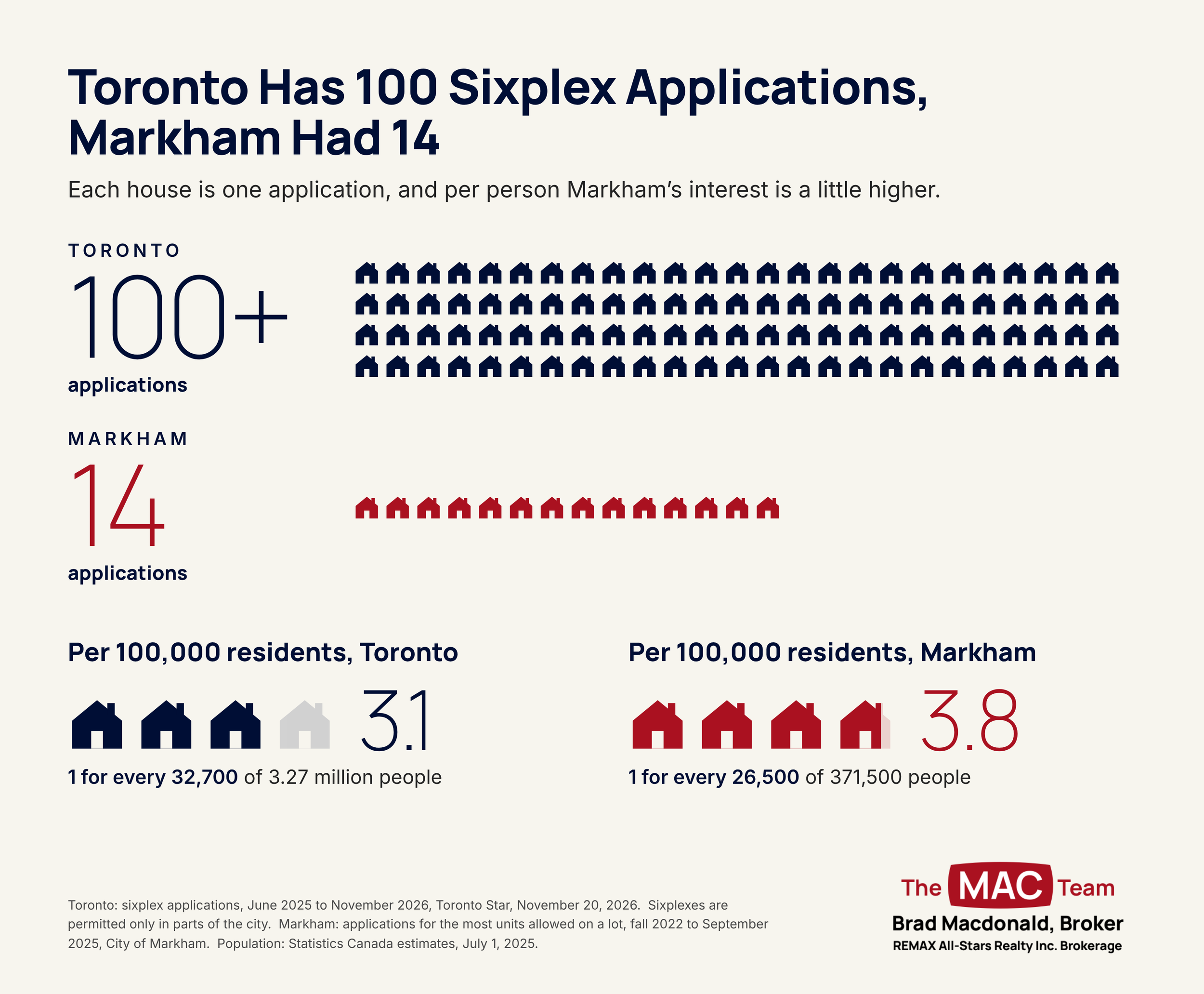
The Toronto Star went through the City of Toronto's permit records last week and found more than 100 applications to build sixplexes since the city began allowing them in parts of town in June 2025. That is about 40 more than the city itself had reported a week earlier, and the gap turned out to be a filing problem rather than a housing one, since "sixplex" and "multiplex" are not building code categories and a plain search of the permit database missed a good number of them. I read it with Markham in mind, because it tells you something about the fourplex argument we just went through here.
Almost All Of Them Are Downtown
The wards with the most applications were Toronto-Danforth with 23, Davenport with 20, and Toronto-St. Paul's with 16, which are older, walkable parts of the city with narrow lots, streetcar lines, and a long history of houses that were divided into flats decades before anyone used the phrase missing middle. More than 40% of those properties also applied for a garden or laneway suite at the same time, which tells me these are mostly small builders and owners who are stacking every permission the lot allows. Council only permitted sixplexes in the old City of Toronto and East York, plus Scarborough North as a suburban test ward, and the Star's review turned up a single application in that test ward, filed before the new rules even took effect. Seven wards where sixplexes are not permitted as-of-right saw applications anyway, including seven proposals in Eglinton-Lawrence, so there is some pent-up interest at the edges, but the pattern is clear enough: the people who want six units on a lot are mostly downtown. (Having walked through a fair number of these conversions over the years, I'd add that the lots that work for six units tend to be the ones that were already half-converted.)
Markham Had Fourteen
Markham's number is the one I wrote about before the election: 14 applications in three years from owners who wanted to build the maximum on one lot, four of them approved, in a city of roughly 375,000 people. The argument over a fourth unit here ran for most of a year, passed council 7 to 6 in February, was revoked by the mayor in March, and cost the city $7.36 million of its Housing Accelerator Fund money in April. Put those fourteen next to Toronto's hundred and I think both sides of the Markham argument lose a little. The residents who said a fourplex rule would change the look of the street were worried about a wave that, on Toronto's own evidence from its suburban test ward, was unlikely to reach the newer subdivisions in Berczy or Cornell at all. The councillors who voted for the rule were in practice defending one-extra-door that very few people were lining up to build, at the cost of a cheque Ottawa has now partly withdrawn (that’s part of the $58.5 million build-more-homes-deal from the feds).
Toronto's former chief planner, Ken Greenberg, told the Star the policy should not be judged on a year or two because owners and small builders take time to adapt, and that's fair, but I'd expect the older streets near transit to be the ones that adapt first, in Markham as in Toronto.
The new council held its inaugural meeting on Monday, November 23. Mayor Scarpitti was returned with about 72% of the vote, Don Hamilton and Jack Heath took two of the four regional seats, and two incumbents, Alan Ho and Joe Li, were not returned, so the council that voted 7 to 6 in February is a slightly different makeup now. I don't know whether the fourth unit comes back - what I'd watch instead is how the new council proposes to make up the $7.36 million, because Ottawa asked for a plan and the rest of the $58.8 million agreement runs on fast-tracked homes actually being delivered rather than on one bylaw.
The first regular meetings are the General Committee on December 8 and Council on December 15, and the infrastructure and development charge questions that come up there will probably tell us more than anything said on inaugural night.
For a homeowner, my advice is roughly what it was in October, with one adjustment from Toronto's numbers. Three units remain legal on most residential lots across Ontario, so a detached house in Markham with a basement apartment and a garden suite is still within reach without a rezoning, and that is what I would lead with when a deep lot comes to market. The adjustment is that Toronto's applications are on streets where the lots were already wide, the houses were already old, and the transit was already there, so in Markham the same logic points to the older streets of Markham Village, Thornhill, and Unionville near the GO stations rather than the newer subdivisions.
If I were pricing the development potential of a building-lot this winter, I'd price it on the three units I can get approved today and treat anything beyond that as a bonus the next council may or may not deliver.