

What Homeowners need to know: Ontario Building Code changes

If you are a Landlord with rental properties, take note - you must ensure all of your properties are compliant with the NEW building code regulations as of January 1st 2026! Mandatory Carbon Monoxide detectors MUST be installed, or face fines.
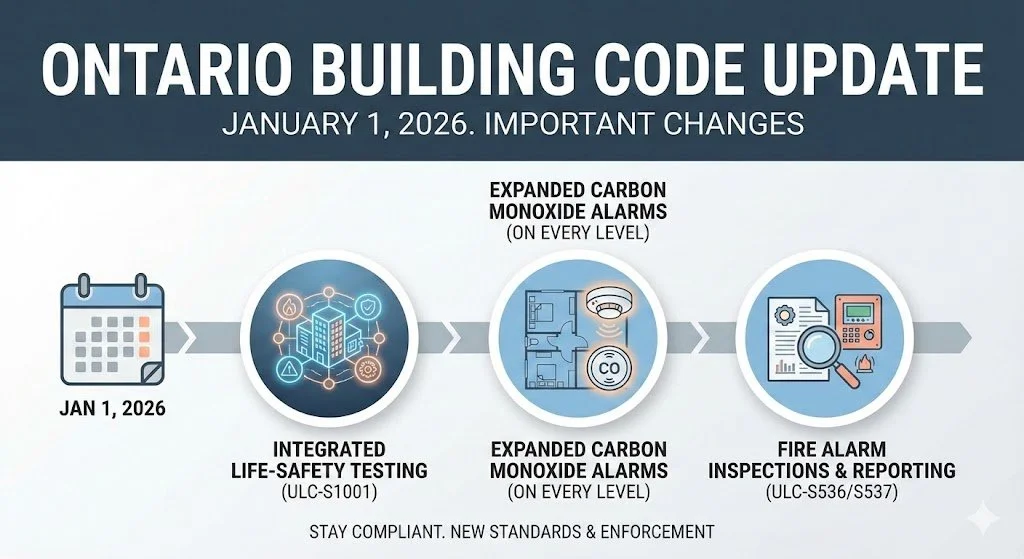

Ontario's Building Code is being updated, with major changes to carbon monoxide (CO) alarm requirements taking effect January 1, 2026, mandating alarms on every floor of homes with fuel-burning appliances, fireplaces, or attached garages, expanding from just near sleeping areas, and applying to multi-unit buildings too, making compliance a legal requirement with significant fines for non-compliance.

Key Changes Effective Jan 1, 2026

  • Every Floor: Alarms must now be on every storey (level) of a home or dwelling unit.

  • Expanded Triggers: Applies to homes with fuel-burning appliances (furnaces, water heaters, stoves, fireplaces), attached garages, or heating from an outdoor furnace.

  • Multi-Unit Dwellings: Rules extend to apartments/condos, requiring alarms in units and sometimes public corridors near fuel systems or garages.

  • Scope: Covers single-family homes, townhouses, and multi-unit residential buildings (apartments, condos).

What You Need to Do

  • Install Alarms: Place CO alarms on every floor and next to each sleeping area if you have a furnace, fireplace, or attached garage.

  • Check Your Appliances: Ensure all fuel-burning devices (furnaces, hot water tanks, stoves) are properly vented and inspected annually by a professional.

  • Buy Certified Alarms: Look for alarms meeting Canadian performance standards (ULC certified).

  • Test Monthly: Test your alarms monthly and replace batteries as per manufacturer instructions (even plug-in models need battery backup).

Why the Change?
Carbon monoxide is an invisible, odorless gas that can cause headaches, dizziness, and death, making early detection crucial. These new requirements provide broader, earlier warning for residents.

Responsibilities

  • Homeowners: Responsible for installation and maintenance in single-family homes.

  • Landlords/Building Owners: Responsible for compliance in rental units and multi-unit buildings.

Penalties
Failure to comply with the Ontario Fire Code is an offence, with potential fines up to $50,000 for individuals and $500,000 for corporations for a first offence.

If those compliance costs have you weighing whether to keep or sell a rental, it helps to know where the property stands first. We offer a free home value consultation for owners across Markham, Unionville and Stouffville.

In Loving Memory of David Macdonald

To our valued Clients and Friends,

With great sadness I have to share the passing of my father David Macdonald.  Many of our wonderful Clients have worked with Dave in the past, to which many have become amazing friends over the years.   

Dave had been battling Cancer for the last few years - continuing to work - often behind the scenes - for as long as he was able.  

I’ve been so lucky to have been brought into the real estate industry by my mother Mary Anne, and was able to join our ‘family team’, alongside Dave and my sister Candice — it’s not too often you get the chance to work so close with so much family.  Dave thoroughly enjoyed the real estate part of his career, with a bias towards the back-office and commercial side of the business.  

I wouldn’t be where I am today without his expert guidance and advice.  Dave will truly be missed.

Insight: Rental Market Reform

Landlords and tenants can both agree that the current Residential Tenancies Act is a major barrier to an equitable and fair rental marketplace. The LTB is seen as a major headache for everyone involved, both prospective Landlords, Tenants and new homeowners. OREA has been proposing a report that outlines achievable updates and goals for a revised RTA, that truly encompasses the realities of today’s rental market.

The goal being to have a fair system that allows for more rental units to be available, with fair market pricing, tools to enable the removal of bad players from the system, and streamlining of the court system to reduce the unrelenting delays that are causing major financial harm.

OREA’s report is summarized below.

Creating Modern Legislation That Works

Ontario’s outdated Residential Tenancies Act, 2006 (RTA), no longer reflects the realities of today’s rental market. Modernization is essential to reducing tribunal backlogs, expanding rental supply, and creating fairer outcomes for both tenants and landlords.

Action-Ready

  • Create a dedicated N12 process for buyers’ personal use to speed up timelines and reduce delays.

  • Strengthen monitoring, enforcement, and penalties against bad-faith N12 evictions.

  • Develop clear, accessible resources to educate both landlords and tenants on their rights and responsibilities under the RTA.

  • Mandate the equal treatment of all individuals under the Condominium Act, 2016, to be inclusive of diverse families.

Long-Term

  1. Review and modernize the RTA to reflect today’s rental market.

  2. Reform rent control by implementing a phased-in approach to balance tenant protections with incentives for new rental supply.

2

Fixing the Broken Landlord and Tenant Board

Ontario’s Landlord and Tenant Board (LTB) is overwhelmed by backlogs and delays, eroding trust and discouraging new rental supply. Urgent reform is essential to restoring fairness, accessibility, and timely justice for both tenants and landlords.

Action-Ready

  1. Move away from the current digital-first strategy and restore in-person hearings as the default.

  2. Improve legal aid support for tenants.

  3. Remove financial barriers for tenant maintenance complaints filed in good faith.

  4. Establish a timely LTB application screening process to identify and remedy errors early.

Long-Term

  1. Find new opportunities to support mediation services between landlords and tenants at the LTB.

  2. Improve LTB adjudicator training, recruitment, and retention strategies.

3

Building a healthy and diverse housing supply

Ontario’s rental supply has fallen far behind demand, leaving families with too few affordable options. Tackling high costs, zoning barriers, and stalled purpose-built development is critical to ensure the market meets the needs of people in every stage of life.

Action-Ready

  1. Reduce government-imposed costs on new rental projects.

  2. Streamline the permit process for new construction.

  3. Promote and help scale innovative approaches to affordable housing development.

  4. Investigate legislative changes needed to provide rent-to-own programs in Ontario.

  5. Provide tax incentives for small landlords who provide new rental units in rapidly growing markets.

  6. Provide a rental renovation tax credit for smaller, independent landlords who invest in specific improvements to their rental properties while keeping monthly rent costs consistent.

Long-Term

  1. End exclusionary zoning across Ontario.

  2. Invest in building 99,000 community housing units over the next 10 years.

Market Update: Stability Returns, But Caution Remain

GTA Market Holding Steady Amid Shifting National Trends

As we head into the summer months, the Greater Toronto Area real estate market continues to demonstrate resilience, with new signs of balance emerging across several segments.

Inventory Levels Signal a Balanced Market

In Toronto, we are currently seeing approximately 4 months of inventory. This level is widely recognized as indicative of a balanced market, where conditions do not strongly favour either buyers or sellers.  This provides some welcome stability after the volatility of the past few years.  However, when we focus on the condo sector, months of inventory trend higher, as sales volumes continue to lag behind the freehold market. This segment may offer greater opportunities for buyers to negotiate or invest strategically.

National Numbers: A Mixed Bag

According to CREA, national home sales rose 3.6 percent from April to May, marking the first month-over-month increase since November 2024. While that is an encouraging sign of renewed buyer activity, it is important to view it in context:

  • Sales remain down 4.3 percent year-over-year, comparing May 2024 to May 2025

  • Average home prices are down 1.8 percent nationally, with Ontario seeing a larger decline of 4 percent

This reflects a still-sensitive landscape where affordability and borrowing costs continue to influence decision-making.

Interest Rates in a Neutral Zone

The Bank of Canada held its benchmark interest rate at 2.75 percent during the last update.  This is considered a neutral rate, meaning it is neither overly restrictive nor particularly stimulating for the housing sector. We are hedging toward the BoC maintaining rates at the upcoming meetings, as our inflation rate has started to creep back up in recent weeks. While stability is generally welcomed by the market, a slightly lower rate would likely encourage more activity among both buyers and builders. This could help support inventory growth and new construction starts, particularly in higher-demand areas.  Market watchers are paying close attention to upcoming announcements.

Trade Talks May Impact the Broader Outlook

Beyond interest rates, broader economic forces are also shaping the market outlook. A finalized Canada–U.S. trade agreement would provide welcome stability for key sectors including construction, manufacturing, and finance. In turn, this would help reinforce consumer confidence and support both urban and suburban real estate markets.

Toronto Real Estate Market Update: May Brings a Slower Spring and More Buyer Power

Sales Slowdown Creates Opportunity

This past May marked one of the slowest spring real estate markets Toronto has seen in over two decades. According to new data from the Toronto Regional Real Estate Board (TRREB), just 6,244 homes were sold across the GTA — a 13% drop compared to the same time last year.

With the exception of May 2020 during early pandemic lockdowns, this is the lowest number of May sales since 2002. And it’s worth noting: our population has grown by over 35% since then.

Home Prices Edge Down Across the Board

The average sale price across the GTA in May was $1.1 million, representing a 4% decline year-over-year. Different property types experienced varying levels of price correction:

  • Semi-detached homes: down 8.4%

  • Condos: down 7.3%

  • Detached homes: down 5.6%

  • Townhomes: down 3.3%

Lower prices combined with slightly reduced borrowing costs have improved affordability, but many buyers remain hesitant due to broader economic concerns.

Inventory Rising, Confidence Lagging

New listings are on the rise. Nearly 22,000 properties came to market in May — up 14% year-over-year. With more listings and fewer sales, the sales-to-new-listings ratio sits at 28%, confirming a buyers’ market. That means:

  • More choice for buyers

  • Greater negotiating power

  • Slower pace = more time to make decisions

Interest Rates, Trade Tensions & What's Next

Market activity continues to be shaped by economic uncertainty, especially around trade with the U.S. and Bank of Canada interest rate decisions. While some expect a rate cut in the near future, the central bank has so far held steady.

Still, we are seeing early signs of recovery: both sales and prices increased slightly compared to April on a seasonally adjusted basis. That’s two months in a row showing a positive trend.

Final Thoughts

For Buyers, this is a rare moment of leverage — more supply, less competition, and room to negotiate.

For Sellers, pricing strategy and strong marketing are critical to stand out in a crowded marketplace.

Whether you’re looking to move soon or just want to better understand your home’s current value, I’m here to help you navigate today’s evolving market.

Toronto New Home Sales Hit Historic Low: Worse Than 1990s Housing Crash

The Greater Toronto Area (GTA) housing market is experiencing an unprecedented downturn. New home sales have fallen to levels even lower than those seen during the 1990s housing crash, signalling serious implications for supply, affordability, and construction activity in the years ahead.

Sales at Record Lows

In April 2025, only 310 new homes were sold in the GTA — a 72 percent decline compared to April 2024, and 89 percent below the 10-year average for the month, which typically sees around 2,750 sales. By comparison, even at the lowest point of the 1990s housing downturn, monthly sales were nearly double what we are seeing today.

Market Breakdown by Housing Type

  • Condominiums: 105 units sold

    • 80% lower year-over-year

    • 94% below the 10-year average

  • Single-Family Homes: 205 units sold

    • 66% lower year-over-year

    • 77% below the 10-year average

Condo sales include units in low, medium, and high-rise buildings. Single-family homes include detached, semi-detached, linked houses, and townhomes.

Price Trends

  • Condos:

    • Benchmark price: $1.019 million

    • Down 3.6% year-over-year

  • Single-Family Homes:

    • Benchmark price: $1.53 million

    • Down 5.4% year-over-year

Market Sentiment and Buyer Behaviour

Buyers are hesitating amid economic uncertainty and speculation about new tariffs. Edward Jegg, research manager at Altus Group, noted, “Buyers crave predictability and the swirling uncertainty around the impact of possible tariffs is depriving would-be purchasers of the confidence they need to move ahead.”

This hesitancy is slowing both transactions and the launch of new housing projects.

Warning Signs of a Future Supply Crisis

BILD warns that the public may not yet realize how serious the slowdown is due to the lag between sales and construction. Justin Sherwood, Senior VP at BILD, noted that the industry is “decelerating quickly” and that a significant housing supply shortfall is forming.

  • 2025 condo completions: 30,793 units

  • 2028 forecasted completions: 9,561 units

This projected 69 percent drop in completions could lead to a housing shortage by the late 2020s.

Inventory Levels and Market Balance

Currently, the GTA’s new home inventory would take 15 months to sell at the current rate — well above the healthy range of 9 to 12 months. While inventory decreased slightly month-over-month, low sales are the main reason inventory remains elevated.

Government Policy and Industry Response

The federal government recently proposed a GST rebate for first-time buyers purchasing homes under $1 million. However, BILD argues this is insufficient.

Sherwood stated, “Very few new home buyers are first-time buyers. It will not substantially help address affordability, nor will it help significantly stimulate sales and construction.”

BILD is calling for GST relief to be extended to all new home purchasers.

Toronto’s new home market is currently enduring the most prolonged sales slump on record. With demand down sharply, prices sliding, and completions projected to fall dramatically, the GTA faces the dual threat of short-term instability and long-term housing shortages.

As this market continues to evolve, staying informed is essential for buyers, sellers, and developers alike.