!-- Google Site Verification -->

Social Media Evolution

It is interesting to note how consumption of our marketing materials slowly changes over time — and as should be no surprise to anyone, social media platform engagement evolves as our ‘new buyer’ demographic slowly changes. It’s been interesting to see how longer-form video and marketing material has started to give way to shorter-form ‘quick hits’ — YouTube engagement is a bit lower, while Instagram Reels / Facebook Stories are on the rise.

We are experimenting with doing more short form videos to engage with our audience - and we would love to hear your feedback! We’re starting to create some non-listing-specific video content that is much more general info on the marketplace, with great results so far. Have an idea or suggestion for a video, let us know in comments on any of the platforms you connect with us!

If you didn’t know - check us out on Instagram - @homesresource - https://www.instagram.com/homesresouce

https://www.facebook.com/homesresource

Canada’s New Tax Law on Home Sales: What You Need to Know

A recent Canadian tax law aims to curb speculative real estate sales by penalizing homeowners who sell a property within 365 days of purchase. Introduced in the 2022 federal budget and effective from January 2023, this law requires that any profit from such a sale be reported as business income, making it ineligible for the primary residence exemption. This could result in significant taxes, ranging from 28% to 53% of profits, depending on the seller's income bracket.

Exemptions to the Law

The Canada Revenue Agency (CRA) offers exemptions for homeowners forced to sell due to one of nine specified circumstances, including:

  • Death, illness, or disability

  • Marriage breakdown

  • Job relocation or involuntary job loss

  • Safety concerns or property expropriation

These exemptions are intended to support Canadians facing unavoidable challenges.

Additional Impact on Pre-Sale Condos and Assignments

The new rules also apply to pre-sale condos, where assignment sales are now subject to HST. Under the new policy, the CRA no longer needs to prove the seller intended to flip the property; any sale within a year automatically qualifies as business income unless an exemption applies.

CRA Monitoring and Penalties

The CRA has four real estate audit teams focused on high-risk areas in Ontario and British Columbia to ensure compliance. Non-compliance can lead to steep penalties, including a 50% surcharge on the tax owed and interest if false information is filed.

Tips for Homeowners

To avoid being taxed as a business, homeowners who want to sell should wait until after the 365-day mark to benefit from the primary residence exemption. Selling on day 366 could save substantial tax costs.

New Mortgage Rules Coming December 20234

Starting December 15, 2024, new mortgage rules in Canada should significantly impact many first-time homebuyers, making it easier to enter the market.  These reforms, described as the boldest mortgage changes in decades by the federal government, are intended to help more Canadians, especially first-time homebuyers and younger generations, secure homeownership. The changes will also impact investors in pre-construction properties, making mortgages more accessible. 


Here's what you need to know:

  1. Longer Amortization Periods: First-time buyers will now have the option of a 30-year amortization period instead of the traditional 25 years. This means your monthly payments could be around 9% lower, making it easier to afford a home. However, keep in mind that spreading payments over a longer period means paying more in total interest over the life of the mortgage​.

  2. Higher Insured Mortgage Cap: The insured mortgage limit is increasing from $1 million to $1.5 million. This is crucial for buyers in high-cost cities like Toronto and Vancouver, where home prices frequently exceed $1 million. Now, you can qualify for an insured mortgage with a down payment as low as 5% on the first $500,000, and 10% on the remainder​.

  3. Easier to Switch Lenders: One big change is that you can switch mortgage lenders without having to pass the stress test again at renewal. This increases competition among lenders, giving you a better chance to find more favorable rates​.

These changes aim to make homeownership more accessible, especially for those struggling with high property prices and rising interest rates.  However, as these changes are implemented, the long-term impact on the housing market remains to be seen - ultimately, the increased buying-power could drive up pricing, and once again increase competition. 

An extra $30,000 in your pocket?

I'm sure if you are on our mailing list, you already are well tuned into what has been happening at the Bank Of Canada recently, and we are happy to see that they have continued the downward trend on interest rates, with their additional 0.25% reduction this Wednesday.   Bond rates also almost dropped a full point on Tuesday, likely in anticipation of Wednesday's rate drop - not a 52 week low, but within 0.75 points of it, which should have a direct impact on fixed-rate mortgages most directly. 

August 2024 market statistics

The Toronto real estate market experienced a modest increase in home sales in August 2024, with transactions rising by 0.6% compared to the previous month. However, the market remains well-supplied, as new listings increased by 1.5% year-over-year. The total number of active listings was 46% higher than in August 2023, which has helped keep price growth moderate. The MLS® Home Price Index Composite benchmark fell by 4.6% compared to a year ago, while the average selling price decreased slightly by 0.8% to $1,074,425 

The Bank of Canada’s rate cut announced on September 4 will lead to a further improvement in affordability, especially for those using variable rate mortgages. First-time buyers are especially sensitive to changes in borrowing costs. As mortgage rates continue to trend lower this year and next, we should experience an uptick in first-time buying activity, including in the condo market” predicts Toronto Regional Real Estate Board President Jennifer Pearce.

TRREB reported 4,975 home sales in August 2024 – down by 5.3 per cent compared to 5,251 sales reported in August 2023. New listings entered into the MLS® system amounted to 12,547 – up by 1.5 per cent year-over-year. On a seasonally adjusted basis, August sales edged up on a monthly basis compared to July, whereas new listings were down slightly compared to the previous month.

Looking ahead, while more buyers may enter the market as rates continue to decrease, it may take time for the existing inventory to be absorbed, suggesting a gradual recovery phase.
 

Monthly Discussion - Pricing Strategies

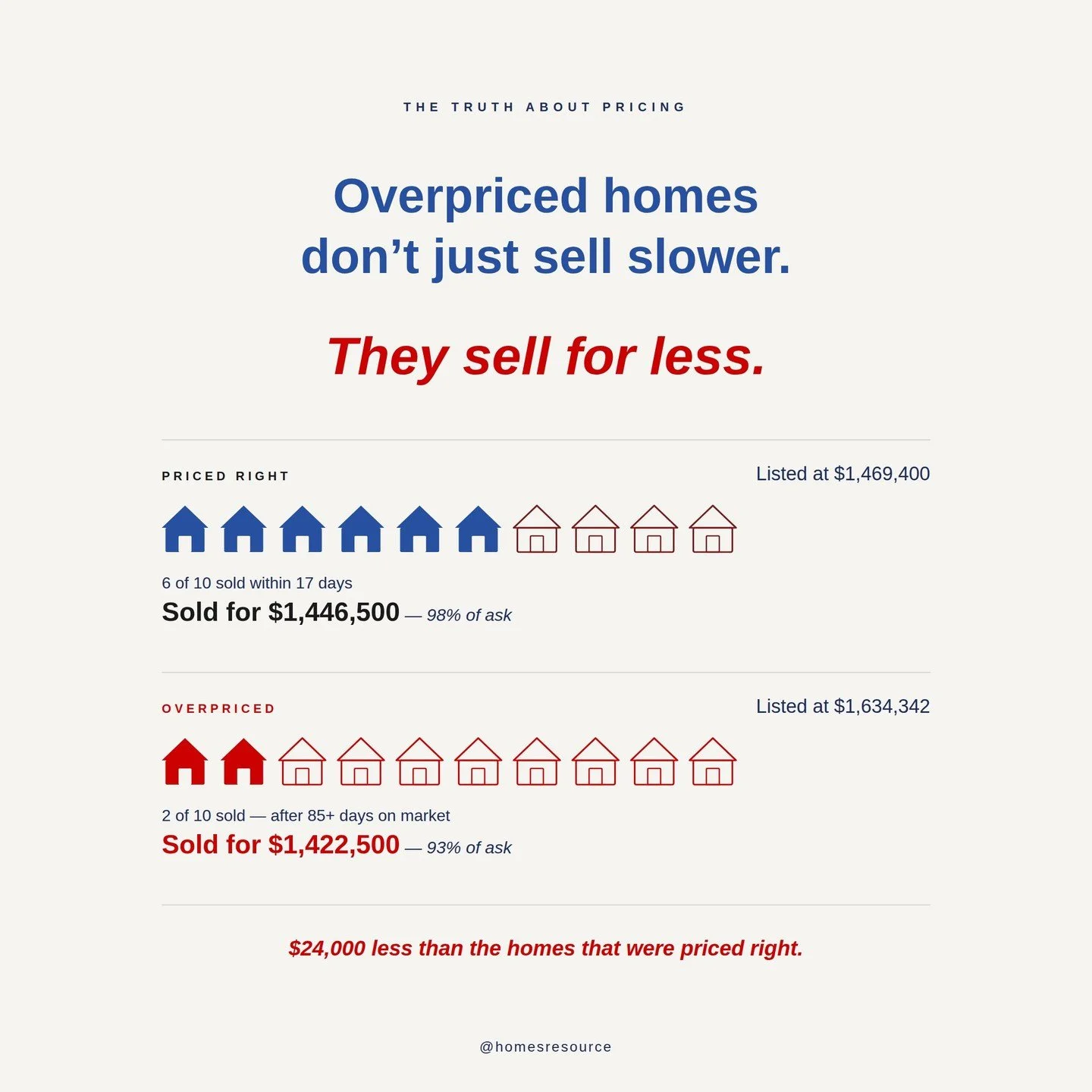
Setting an accurate asking price for a resale home is crucial, especially in a market that is leaning from more or less balanced market, toward a Buyer's market. In such conditions, Buyers have more options and greater leverage, so pricing a property correctly from the start can make all the difference. An overly ambitious asking price can deter potential buyers, causing the property to sit on the market longer. When a home remains unsold for an extended period, it can create the impression that there is something wrong with the property, further diminishing its appeal (often considered a phantom stigma!). This often forces sellers to make price reductions, which can weaken their negotiating position and reduce their overall return. 

➤ We've been watching a couple of improperly priced properties through to their ultimate sale, and can easily say these Sellers have lost between $25,000-$30,000 of value, due to ill-advised marketing foolery 🤯!   We aren't in a market where you can just guess at a price - do the homework, and price to what the market will bear.

In the Toronto market today, we are seeing around 25% of listings are getting 're-listed' within 30 days with a new price & strategy.  A poorly priced home can quickly become stale and extend its days on the market unnecessarily, not only increasing carrying costs for the Seller but also decreasing Buyer interest - properties that have been on the market longer are often perceived as less desirable.

➤ To avoid this cycle, setting a competitive and realistic asking price based on comparable sales and current market trends is essential. Coupled with a strong marketing strategy, accurate pricing helps attract serious buyers quickly, reduces the time on the market, and ultimately leads to a more successful sale, and hopefully, an extra $30,000 in your pocket! 

New Listings vs. Re-Listings - August 2024
 

A few samples of listing data from around the GTA for the month of August:

The average days-on-market fluctuates with the area, but we are typically seeing around 26-35 days for 'well priced' properties, and 46-65 days for ones with what we would call 'creative pricing'.  Generally speaking, the marketing strategy of marketing at a very reduced (under-market value) price point, and 'holding of offers' for a specific day, has had limited success -- most Buyers are simply waiting-out the Sellers, and hence why we see such a significant number of re-listings around the GTA. 
 

Moral of the story - get it priced right, right from the beginning!

Homeowner Protection Act 2024 Announced

Yesterday, the Government of Ontario announced the Homeowner Protection Act, 2024 – with several major wins for Ontario REALTORS® and hardworking families across the province, which OREA has advocated for in recent months and years.

The Act includes several REALTOR®-led advocacy priorities, most notably a 10-day cooling-off period for buyers of newly built freehold homes. This will allow purchasers 10 days to review and cancel an agreement without penalty, a protection that is already in place for pre-construction condo sales in Ontario. Extending this protection to newly constructed homes will enhance consumer protection and level the playing field between hardworking families and corporate developers.

Notably the Government will not be extending this protection to resale homes, which would have negatively impact both buyers and sellers.

The new legislation also bans the registration of Notices of Security Interest (NOSIs), reducing unnecessary fees from being tacked onto the price tag of a home. Too many Ontarians, when selling their home, have been surprised by one or more NOSIs – fine print in contracts for water coolers, furnaces, or security systems that include exorbitant buyout charges to be paid before the home can be sold.

Additionally, the Act will modernize zoning rules to allow for more homes to be built near public transit, making it easier and faster to increase Ontario’s housing supply in urban areas – a change that OREA has long-advocated for, including in their recent report, Analysis of Ontario’s Efforts to Boost Housing Supply.

The Homeowner Protection Act, 2024 is a significant step toward enhancing consumer protection for Ontarians making one of the largest transactions in their lives, all while building much-needed housing supply across the province.

Bank of Canada maintains overnight rate

Wednesday April 10, 2024 - OTTAWA The Bank of Canada has maintained its overnight rate target at 5%, with the Bank Rate at 5¼% and the deposit rate at 5%. The Bank expects the global economy to continue growing at a rate of about 3%, with inflation in most advanced economies easing gradually. The US economy has proven stronger than anticipated, buoyed by resilient consumption and robust business and government spending.

One key cause for concern is a housing market that's showing signs of heating up. The benchmark average home price in Canada is down more than 17 per cent from its peak in 2022. But the numbers for December and January indicate the market may have bottomed out and started to rebound.

The Bank has revised its forecast for global GDP growth to 2.7% in 2024 and about 3% in 2025 and 2026. Inflation rates are projected to reach central bank targets in 2025. In Canada, economic growth stalled in the second half of last year and the economy moved into excess supply.

2024 Budget: Changes to the Non-Resident Speculation Tax (NRST)

With the recent release of the 2024 Ontario budget, the province is making some changes to the Non-Resident Speculation Tax (NRST). The NRST is the tax on the purchase or acquisition of an interest in residential property located anywhere in Ontario by individuals who are not Canadian citizens or permanent residents of Canada or by foreign corporations or taxable trustees.

Effective March 27, 2024, the following changes include:

  • The rebate application deadline for foreign nationals who become permanent residents of Canada has been extended from 90 to 180 days.

  • The NRST will now apply to the standalone purchase of a parking space or storage unit. Previously this only applied if the spaces were coupled with the purchase of a residential unit.

Changes were made to the qualifying rules for rebates and exemptions under the NRST:

  • A purchaser must intend to occupy the home as their principal residence within 60 days of their purchase date.

  • A purchaser must occupy the home as their principal residence until a rebate application is filed to remain eligible for a rebate.

  • Enrolment or Employment for the international student/worker rebates must begin within 30 days of home purchase. (The rebates have been eliminated but transitional provisions allow applications until March 31, 2025).

  • Spousal status must be obtained on or before the date of home purchase to be eligible for the exemption or rebate.

  • Exemptions and rebates are not available if a foreign entity who is not on title acquires a beneficial interest in the home.

View the Ministry of Finance Letter on Changes to the NRST for more details. For further information on the Non-Resident Speculation Tax, click here.

BOLD Action Builds Homes

The housing supply and affordability crisis are pushing the dream of homeownership further out of reach for Ontario families.

Last month, OREA released their latest policy report, Analysis of Ontario’s Efforts to Boost Housing Supply. The report outlines 10 action items, based on the recommendations of Ontario’s Housing Affordability Task Force, that will increase housing supply and address the housing affordability crisis. Actions include:

  • Allowing water and wastewater services to be provided through a municipal services corporation, lowering up front costs of purchasing a new home by up to $50,000;

  • Supporting commercial-to-residential conversions with greater density along transit corridors; and

  • Ending exclusionary zoning to unlock more housing supply in existing communities.


Together, all 10 action items would improve affordability and create future generations of homeowners. Read more in last week's Toronto Star op-ed by OREA CEO Tim Hudak.

Please encourage your MPP to take bold action to build more homes.

Changes coming December 1st - TRESA Phase 2

t hasn't been in the mainstream news much yet, but Phase 2 of the updated "TRESA" Trust in Real Estate Services Act - which dictates guidelines for Real Estate transactions in Ontario, is being implemented as of December 1st.
 

TRESA Phase 2


These changes have significant impact on how you will (or will not) be working with your chosen Realtor, and offers some additional choices for both Buyers and Sellers in their transactions.

Currently, as a Realtor, we have options to work with Buyers as 'Clients' where we represent their interests in a transaction, or simply as a 'Customer' where we may be also representing the Seller in a transaction, and are only providing cursory guidance to the Buyer, to facilitate the transaction. 

As of December 1st, the 'Customer' relationship will no longer be allowed.  You would either be a Client of the Realtor/Brokerage, or opt to be 'Self Represented'.  The difference here, is that as a Realtor, I would be forbidden for giving *any* insight, advice, or market-knowledge to any Self Represented parties.  They cannot discuss service options, opinions, advice of any kind, or do anything that would encourage a Buyer to rely on our knowledge, judgement or skill. They would completely be acting on their own.  

Buyer Representation agreements - "designated representatives" becomes much more critical as of the December 1 implementation, where we clearly describe the duties owed to a Buyer and Seller in every transaction.  

Once these changes come into effect, we will be allowed to share some detailed information guides, provided by RECO - the Real Estate Council of Ontario.  Linked below is an advanced copy of a standard RECO Information guide, which will replace our current "Working with a Realtor" form we utilize today. It gives a good overview of these basic changes.


Another significant change will be the ability to share the contents of offers on a property, with the Seller's written permission.  Sellers can opt-in or out, and can also change their mind - but this option of sharing some non-personal details of offers (i.e. price), can change the dynamic of bidding-wars on desirable properties with multiple interested Buyers.  We are sure to see a lot of variation on implementation of this option, and sure to see more on mainstream news channels as the market heats up.

From the Realtors perspective, our services we can offer remain fundamentally the same, however all the years of standardized forms and clauses we rely on, need to be updated to reflect the current terminology and scenarios.  Its going to be a bit of the wild-west for a few weeks, while we have a mix of deals that have both old and new forms... There is sure to be significant Agent confusion during the change.

In December, we will share some additional resources on all the changes coming your way - including what's next in January!

Higher Borrowing Costs See Buyers Remain on Hold

Lack of affordability and uncertainty remained issues for many would-be home buyers in the Greater Toronto Area (GTA) in October 2023. As a result, sales edged lower compared to last year. However, selling prices remained higher than last year’s levels.

“Record population growth and a relatively resilient GTA economy have kept the overall demand for housing strong. However, more of that demand has been pointed at the rental market, as high borrowing costs and uncertainty on the direction of interest rates has seen many would-be home buyers remain on the sidelines in the short term. When mortgage rates start trending lower, home sales will pick up quickly,” said TRREB President Paul Baron.

REALTORS® reported 4,646 GTA home sales through TRREB’s MLS® System in October 2023 – down 5.8 per cent compared to October 2022. On a month-over-month seasonally- adjusted basis, sales were also down in comparison to September.

New listings in October 2023 were up noticeably compared to the 12-year low reported in October 2022, but up more modestly compared to the 10-year average for October. New listings, on a seasonally-adjusted basis, edged slightly lower month-over-month compared to September 2023.

Risky Private Mortgages On The Rise

The reality for many prospective home purchasers is that it is getting more and more difficult to secure stable financing from conventional financial institutions, with the continual rise of interest rates, and the even-more-challenging ‘qualifying rates’. Many buyers with long closing dates are finding that while they may have previously been approved for a conventional mortgage, banks are rescinding approvals prior to closing, putting buyers in compromising positions. In order to avoid the legal costs and battle of simply failing-to-close on a purchase, many are turning to the unregulated private sector to get deals done.

The Toronto Star had a great article on this uprise of Private Mortgages, and the high costs, and risks, involved.

One issue is private lenders’ agreements are often just one-year contracts, and they could call in the loan at the end of it.

“Even though you’ve been a good borrower, they may be like ‘I need my money back,’” she said, adding she tends to think of private lenders as a last resort. Sialtsis said anyone using a private lender needs to ensure they have a “solid” exit strategy.

While a needed option for many, looking to unregulated funding should be an absolute last-resort option, when all conventional avenues fail.

Fraud in Toronto's Residential Rental Marketplace

The residential rental market in Toronto, a city renowned for its multiculturalism and vibrant lifestyle, has long been a hotspot for real estate investment and urban living. However, amidst the gleaming high-rises and charming neighborhoods, a darker underbelly of fraud has emerged within the rental marketplace. Fraudulent activities within Toronto's residential rental market are a cause for concern, impacting both landlords and tenants and creating a need for increased awareness and vigilance.

The Rising Menace of Rental Fraud

Rental fraud in Toronto encompasses a range of deceptive practices that exploit the high demand for housing, creating lucrative opportunities for scammers. One of the most common forms of rental fraud involves fake listings. Fraudsters lift property information and photos from legitimate listings and post them on various online platforms, offering properties at prices that seem too good to be true. Unsuspecting tenants are then lured into submitting deposits or payments for these non-existent rentals.

Additionally, there are cases where fraudsters pose as landlords or property managers, conducting viewings and collecting application fees before disappearing without a trace. This type of fraud exploits tenants' eagerness to secure a desirable property in a competitive market.

Red Flags and Warning Signs

Several red flags can help tenants and landlords identify potential rental fraud:

  1. Unrealistically Low Prices: If a listing's rent is significantly lower than the market average for a similar property, it's essential to exercise caution.

  2. Pressure to Act Quickly: Scammers often create a sense of urgency, pressuring applicants to submit payments or personal information hastily.

  3. Lack of In-Person Viewing: Beware of landlords or agents who refuse to schedule an in-person viewing or offer excuses for their absence.

  4. Requests for Payment Before Signing: Legitimate landlords typically request a deposit or payment after signing a lease agreement, not before.

  5. Incomplete or Suspicious Contact Information: Be wary of listings with generic email addresses or phone numbers that don't match the property location.

  6. Requests for Personal Information: Fraudsters might ask for sensitive personal and financial information upfront, which should be a major red flag.

Preventing Rental Fraud

Both tenants and landlords can take steps to protect themselves from falling victim to rental fraud:

For Tenants:

  1. Research Extensively: Thoroughly research the property, its owner, and the local rental market to verify the legitimacy of the listing.

  2. Visit in Person: Whenever possible, conduct an in-person viewing of the property before committing to anything.

  3. Deal with Reputable Platforms: Use well-known and reputable online rental platforms, as they tend to have stricter verification processes.

  4. Check Landlord References: Ask for references or previous tenant contact information to confirm the landlord's credibility.

For Landlords:

  1. Screen Applicants: Implement a rigorous screening process for potential tenants, including background and credit checks.

  2. Document Everything: Keep records of all interactions, including emails, messages, and signed agreements.

  3. Meet in Person: Whenever feasible, meet potential tenants in person during viewings or lease signings.

  4. Use Secure Payment Methods: Encourage tenants to use secure payment methods for deposits and rent.

As Toronto's residential rental market continues to thrive, so does the menace of rental fraud. Tenants and landlords must remain vigilant and informed to protect themselves from falling victim to deceptive practices. By recognizing the red flags, conducting thorough research, and utilizing secure processes, both parties can contribute to a safer and more trustworthy rental marketplace.

Collaborative efforts from regulatory bodies, your favourite real estate professional, and technology platforms can help combat rental fraud, but you must be diligent in your research and tread carefully!

Are you a Landlord or prospective Tenant and need assistance with a rental property? Contact Us anytime!

Interest Rate Talk

In recent years, interest rates in Canada have remained historically low. However, it's important to note that interest rates are subject to fluctuations based on various factors, including the overall economic conditions and monetary policy decisions made by the central bank, the Bank of Canada.  We’ve seen the BOC continue to put upward pressure on interest rates, with continual 0.25 point increases, with most factors pointing to another raise in rates in July.

While interest rates have a profound impact on multiple sectors, they are particularly significant for the real estate market.

Mortgage Affordability:

When interest rates are low, homebuyers can benefit from lower borrowing costs. This can increase affordability and incentivize prospective buyers to enter the market or consider purchasing higher-priced properties. Lower interest rates translate into lower monthly mortgage payments, making homeownership more accessible to a broader range of individuals and potentially driving up demand in the GTA.

Demand and Property Values:

Low interest rates can fuel demand in the real estate market. As more buyers enter the market, the demand for properties increases, leading to rising property values. This can be positive for homeowners, as it can contribute to equity growth and increased net worth.

Housing Market Stability:

While low interest rates can stimulate the real estate market, a sudden and significant increase in interest rates could have the opposite effect. Higher borrowing costs may reduce affordability, which can lead to a decline in demand and a potential slowdown in the housing market. Homeowners looking to sell their properties might face challenges if the market experiences a shift in buyer sentiment due to increased interest rates.

Rental Market:

Interest rate trends can also impact the rental market significantly. Higher interest rates can increase borrowing costs for real estate investors, affecting their profitability and returns. If investors find it less lucrative to purchase properties for rental purposes, the rental market may experience reduced supply, potentially leading to increased rental prices – which is the trend we are seeing all around Toronto and the GTA, with record-high rental prices.

Interest rate trends have a significant influence on the real estate market in the Greater Toronto Area. Low interest rates have contributed to increased affordability, rising property values, and a robust housing market. However, it's important to remember that interest rates are subject to change based on economic conditions and policy decisions. As a result, prospective homebuyers, homeowners, and real estate investors should closely monitor interest rate trends to make informed decisions. Consulting with mortgage professionals and real estate agents can provide valuable insights into the potential impact of interest rate changes on the GTA real estate market.