!-- Google Site Verification -->

Marketwatch for March 2023

March 2023 home sales accounted for an increased share of listings in comparison to March 2022, suggesting that competition between buyers is on the rise.

What’s interesting is that we do see a marked decrease in year-over-year average selling price (down 14.6%), however that may not last - since we are still not seeing the influx of 'spring' listings hitting the market, so expect the competition to only increase in the meantime., and bring prices up along with it.

How do we answer the most common question we hear in the industry? 

“Whats happening with the home prices in my area?”

That question has been a tough one to succinctly answer for quite some time.  Everyone is well aware that we’ve been going through a rapid transition, being pushed by the Bank of Canada’s interest-rate changes over the last 6 or so months.

Opinions on the home-price trajectory were significantly different depending on your source - even the big-3 banks had wildly different projections (dips year-over-year anywhere from 10% to 40% or more) - however, what we see in a more thorough look at our market segments is often quite different.

One of the biggest factors that influence these statistics (aka clickbait) is the reality that in many cases, what we are seeing ‘on the market’ in a year-versus-lastyear comparison, are not necessarily “like for like” homes.  When the market is on the upward trend, we tend so see more highly-upgraded, highly-desirable properties on the market - which tend to dominate the upper end of the sales in each segment.  However, when we are progressing through a softer marketplace, where prices have been receding from recent highs, many of those top-tier homeowners may opt for the sit-and-wait approach.  

As we search with our Buyer-clients, we start to see this through the available inventory at any given time — the number of purely average homes starts to increase versus those higher-end gems.  These homes of course, tend to command lower prices, even in the best of times - becoming a bit of a self-fulfilling prophecy.  


If we don’t see the best-of-the-best up for sale, it’s obvious that we will see lower sale prices in current statistics.

The good news for Realtors, is that homeowners understanding and acceptance of this more modest market is starting to take hold.  We are seeing smaller gaps between asking and sale prices, as Vendors are adjusting to market realities, and list-prices are becoming more in-line with realistic expectations.   This is a win-win for everybody, as there is nothing more challenging than a Vendor that has the mental valuation of their home from the peak in late 2021!

In summary, in the majority of the communities around the GTA, we are seeing a rather balanced marketplace.  A welcome return to truly ‘negotiating’ a deal, and a much less stressful environment for many buyers.   Sure, there still are those gem’s out there commanding multiple-offers and offer-review dates, but they are much more of a minority than a year ago today.

Curious for more details on your homes valuation in today’s market? Feel free to connect with us - we are always happy to offer free, no-commitment home evaluations, just ask!

Stock Media provided by AndreyPopov / Pond5

January 2023 Market Statistics

Likely not surprising to most, but the continued upward pressure on interest rates, has continued to take some steam out of the sails of the marketplace. Average selling price in the GTA is down about 16% from 2022 levels, with over 44% less completed sales. The reality of our market however is that these statistics can be quite misleading about what is actually available on the marketplace — often, when times are less-than-ideal, the most desirable properties don’t often come up for sale. We are inevitably looking between less impressive offerings, which my their nature, command lower offering prices… To really understand what is going on out there, you need to look deeper at actual ‘comparable to you’ properties - ones that could be true alternatives for a purchasing decision, and track their sales year to year.

Toronto's Vacant Home Tax

As of January 1st, 2023, Toronto has now implemented a “vacant home tax”, directed at properties that are not occupied for at least 6 months of the year.

What you need to know:

Residential properties in Toronto that are unoccupied for more than six months (cumulative) in a calendar year, may be subject to the new City of Toronto's Vacant Home Tax (VHT), unless they meet one of the exemptions. The VHT was created to improve the supply of housing in the city.

  1. A declaration form will need to be completed by property owners by February 2, 2023.

  2. A property is considered vacant if it is not the principal residence of the owner or any permitted occupants or was not occupied by tenants for at least six months during the previous calendar year or is otherwise deemed to be vacant under the bylaw.

  3. The tax is 1 per cent of the current value assessment (CVA) of the home.

  4. Exemptions include principal residence, death, repairs, units undergoing major renovation, owner is in care or hospital, court order, transfer of legal ownership and occupancy for full-time employment is in place.

When Buying or Selling:

The Vacant Home Tax has implications for property transactions, both for purchasers (buyers) and vendors (sellers):

  • It is the responsibility of buyers and sellers to make the appropriate arrangements to ensure that the declaration has been filed.

  • The Vacant Home Tax will form a lien on the property, and any unpaid taxes will become the buyer’s responsibility.

  • If a closing occurs between January 1 and the closing of the declaration period on February 2, the seller must complete the declaration prior to the closing, as only the seller will know the property’s occupancy status for the prior year.

  • If a closing occurs after the declaration period – February 3 to December 31 – the buyer must submit a declaration in the following year. The buyer qualifies for the “transfer of legal ownership” exemption.

  • The seller should provide a copy of the completed and filed property status declaration to the buyer.

  • The seller should provide a statutory declaration at closing confirming the filed property status declaration is true and correct.

The goal of the VHT is to increase the supply of housing by discouraging owners from leaving their residential properties unoccupied. Homeowners who choose to keep their properties vacant will be subject to this tax.

Property Days-On-Market report for Dec 2021

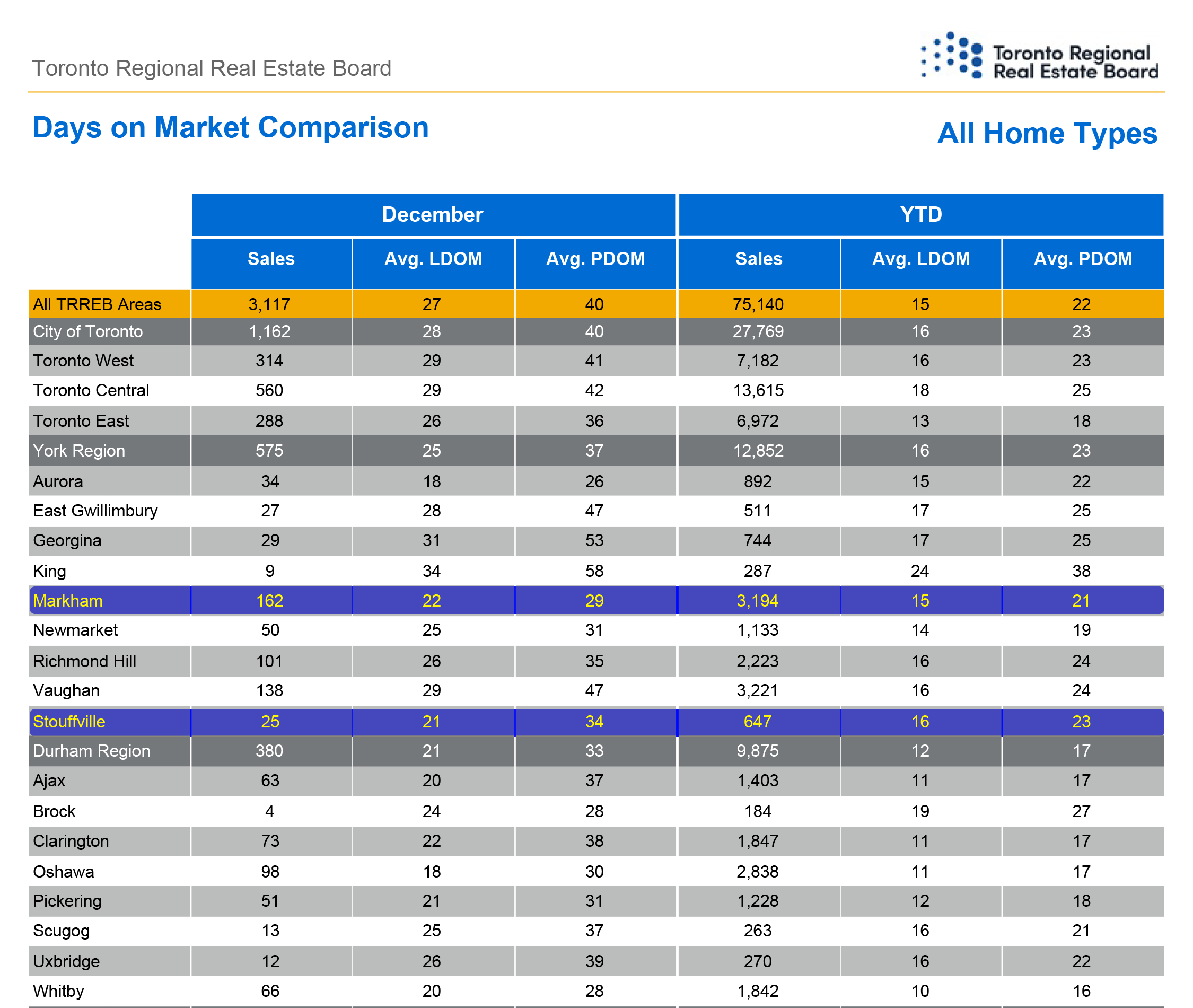
The Toronto Regional Real Estate Board has just released the latest PDOM data for December 2021. I’ve highlighted a couple of local areas of interest in the chart below.

Properties Days On Market - December 2021 TRREB

Markham and Stouffville both saw an expected increase in the total property-days-on-market for December, above the yearly average, with Markham’s increasing to 29, and Stouffville’s up to 34. This is a somewhat expected increase that we typically see in the slower-moving marketplace prior to the holiday season.

If you are interested in the full list for the TRREB market areas, click this link for the full PDF version.

👉🏻 Chat with us if you are curious to how this may affect your selling or buying strategy!

GTA REALTORS® Release October Stats

Despite the continued housing market transition to a higher borrowing cost environment, the average selling price in the Greater Toronto Area (GTA) found some support near $1.1 million since the late summer. GTA home sales continued to adjust to substantially higher interest rates in October 2022, both on an annual and monthly basis. However, new listings are also down year-over-year and month-over-month. The persistent lack of inventory helps explain why the downward trend in home prices experienced in the spring has flattened over the past three months.

GTA REALTORS® reported 4,961 sales through the Toronto Regional Real Estate Board’s (TRREB) MLS® System in October 2022 – a similar number to September 2022 but down by 49.1 per cent compared to October 2021. Yearover-year sales declines were similar across major market segments.

New listings were down by 11.6 per cent year-over-year and reached an October level not seen since 2010. New listings were down on an annual basis more so for mid-density and high-density home types, which helps to explain why prices have held up better in these categories compared to detached houses.

“With new listings at or near historic lows, a moderate uptick in demand from current levels would result in a noticeable tightening in the resale housing market in short order. Obviously, there is still a lot of short-term economic uncertainty. In the medium-to-long-term, however, the demand for housing will rebound. Public policy initiatives like the recently introduced provincial More Homes Built Faster Act and strong mayor provisions will help ensure we see more homes being built to affordably meet the needs of new households,” said TRREB President Kevin Crigger.

The MLS® Home Price Index (HPI) Composite Benchmark was down by 1.3 per cent year-over-year in October 2022. The average selling price for all home types combined, at $1,089,428, was down by 5.7 per cent compared to October 2021. The monthly trends for both the MLS® HPI Composite and the average selling price have flattened in recent months following steeper declines in the spring and early summer.

“Home prices in the GTA have found support in recent months because price declines in the spring and summer mitigated the impact of higher borrowing costs on average monthly mortgage payments. The Bank of Canada’s most recent messaging suggests that they are reaching the end of their tightening cycle. Bond yields dipped as a result, suggesting that fixed mortgage rates may trend lower moving forward, which would help affordability,” said TRREB Chief Market Analyst Jason Mercer.

NBA x REMAX

REMAX has just launched its new NBA marketing affiliation with the start of the 2022/23 basketball season.

YES IN YOUR HOUSE CONTEST

Official Real Estate Agents of the NBA

Enter today for your chance to WIN a customized, designer game night space in your house. YES, in your house.

https://www.remax.ca/yesinyourhouse

No Purchase Necessary. See site for official rules. CA residents, 21+, excl. QC. Ends November 21, 2022. Each office independently owned and operated.

Canadian Housing Market Outlook

RE/MAX Canada Network expects Canadian housing market prices to decrease 2.2 per cent this fall


Toronto, ON and Kelowna, BC, September 28, 2022 – RE/MAX brokers and agents are anticipating the national average residential sale price in the Canadian housing market to decline 2.2 per cent in the final months of the year (September-December), according to RE/MAX’s 2022 Fall Canadian Housing Market Outlook Report. This market moderation comes on the heels of rising interest rates, record-high inflation and broader global and economic uncertainties that have impacted consumer confidence and market activity. Bucking the downward trend, seven out of 30 Canadian housing markets analyzed are likely to experience modest price appreciation between 1.5 and seven per cent. Meanwhile, RE/MAX brokers and agents expect a decline in sales this fall, in 18 out of 30 markets surveyed.


Despite the fact that nearly half of Canadians are waiting to buy or sell a home, we’re confident that as economic conditions improve by mid-2023, activity will resume,” says Elton Ash, Executive Vice President, RE/MAX Canada. “Timing the market for short-term investment is extremely difficult and rarely successful. But as a long-term investment, the Canadian housing market continues to yield solid returns. If someone needs to buy or sell, regardless of those cyclical peaks and valleys, being informed and working with an experienced real estate professional can help consumers clarify some of those unknowns and make the best decision possible.”


Ontario

Much like other provinces across the country, Ontario has not been immune to the impacts of rising interest rates. Many markets including Oakville, Windsor, Barrie, Durham, Kingston and Kitchener-Waterloo, anticipate – and in some cases already experiencing – a reduction in the number of units sold over the coming months. Apart from Oakville and Muskoka, average residential sale prices in Ontario are likely to remain steady or decrease between two to 10 per cent in the fall months.

Similar to Western Canada, the luxury market has remained resilient and in-demand among buyers in Oakville, despite rising interest rates and a looming recession – a contributing factor to the modest two-per-cent average residential sale price increase expected in Oakville this fall. Muskoka continues to attract homebuyers to the area, while simultaneously, many sellers are eager to sell before year-end. Given a steady stream of demand, Muskoka is expected to experience a modest five-per-cent increase in average residential sale price this fall. In Peterborough, interest rate hikes and the subsequent effects on the stress test have eroded affordability in the area, which is the main factor contributing to the seven-per-cent decrease in average residential sale price expected in the coming months. The return of conditional offers has been a prevalent trend across the province, including in Kingston, Kitchener-Waterloo, Muskoka and Peterborough. Echoing many regions across Canada, Durham, London, Sudbury, Ottawa, the Lakelands and the Greater Toronto housing market are expected to regain balance in 2023, albeit with low inventory continuing to place upward pressure on prices. As one of the more affordable markets in Ontario, Thunder Bay is unlikely to experience any significant fluctuations in average residential sale prices this fall.


Never give up on a dream just because of the time it will take to accomplish it.

Never give up on a dream just because of the time it will take to accomplish it.” - Earl Nightingale

This summer-of-change in the economy and real estate marketplace has left many a buyer and sellers frustrated, confused, and sometimes at wits-end. We all know however, that if you keep at it, focus on what matters most, and take sage advice, ultimately you can have success.

We are thrilled for our clients Keith & Brianna to have won the long-fought battle to find them their perfect first home this summer! We likely set a new record for viewing various options, and despite the up-and-down emotional rollercoaster along the way, we held out to ultimately find the absolute perfect place. Big thank you from The MAC Team for letting us guide you on this journey!

Congrats Keith and Brianna on your first home!

The take-away for first time buyers is to be relentless - don’t give up on that dream of home ownership! It can be a challenge, but with informed guidance, shrewd negotiations, and perhaps a smidge of good luck, it’s all attainable, even in today’s challenging marketplace. 🏡

Mortgage Rate Snapshot

Current market conditions are being driven by the continued increase in the overnight lending rates by the Bank of Canada. Bond yields have gone up, slightly increasing the fixed rates. Variable rates are still the same until the next Bank of Canada announcement on July 13th, 2022.

As a quick snapshot, here are some sample rates from a local Mortgage Broker:

  • Prime Rate: 3.70%

  • Variable: 2.65%

  • 3-Year Fixed: 4.29%

  • 5-Year Fixed: 4.34%

Greater Toronto Housing Market: 25-Year Comparison

Average price increased more than 450 per cent, while unit sales have doubled since 1996 

Residential unit sales in the Greater Toronto housing market have doubled and average price has increased more than 450 per cent since 1996, as strong demand and limited supply continue to drive rapid price escalation throughout the 416 and 905 area codes, according to a new report released by RE/MAX Canada.

Between 1996 and 2021, more than two million homes sold in the GTA, representing a dollar volume in excess of $1.1 trillion. Average price has soared over the 25-year period, rising close to 453 per cent, from $198,150 in 1996 to $1,095,475 in 2021, at a compound annual growth rate of 7.08 per cent. Statistics Canada reports the Toronto CMA reached 6,202,225 in 2021, an increase of 45 per cent over the 1996 Census figure of 4,263,759.

Market Stats March 2022

There were almost 11,000 Greater Toronto Area (GTA) home sales reported in March 2022, capping off the third-best March and second-best first quarter on record. Tight market conditions continued to support a double-digit annual pace of price growth, with an average selling price of $1.3 million. The average selling price dipped slightly month-over-month, bucking the regular seasonal trend.

“Now is the time for governments to govern and focus on measures that are proven to increase housing supply. The GTA population will experience rapid growth in the coming years as our region’s economic strength and diversity continues to attract people from around the world. In order to sustain this growth, we need adequate housing supply and choice. This needs to be the focus of policymakers rather than short-term and ineffective measures to artificially suppress demand. Evidence-based decision-making should inform government policies, and we encourage representatives at all levels of government to think big and act decisively to improve needed housing supply in a significant way,” said TRREB President Kevin Crigger.

GTA REALTORS® reported 10,955 sales through TRREB’s MLS® System in March 2022, representing a 30 per cent decline compared to the record result of 15,628 in March 2021. While sales were down year-over-year for all major market segments, condominium apartment transactions dipped by a much lesser annual rate.

New listings were also down on a year-over-year basis, but by a much lesser annual rate than sales. This suggests that while market conditions remained very tight, home buyers did not experience the same level of competition from other buyers compared to a year earlier.

The MLS® Home Price Index Composite benchmark was up by 34.8 per cent year-over-year in March 2022. This annual rate of increase was down slightly from February. The average selling price was up by 18.5 per cent year-over-year. The annual growth rates for the MLS HPI® and average selling price differed, in part, because the mix of homes sold in March 2022 shifted in favour of condominium apartments which generally sell for a lower average price compared to other home types.

“Competition between home buyers in the GTA remains very strong in most neighbourhoods and market segments. However, we did experience more balance in the first quarter of 2022 compared to last year. If this trend continues, it is possible that the pace of price growth could moderate as we move through the year,” said TRREB Chief Market Analyst Jason Mercer.


Link for full Market Watch report for March 2022

The Housing Race

Great article in the Toronto Star, confirming the reality of one aspect of the housing market today — it’s one heck of a race. With the Bank Of Canada delaying an interest-rate increase for a little while longer, the market is sure to react with a continued buyers-frenzy. Locking in at all-time low mortgage rates is high on the list for many prospective home buyers, so the demand for the already-limited inventory is sure to become even higher.

Read Article - Toronto Star

https://www.thestar.com/business/2022/01/27/now-its-a-race-homebuyers-will-rush-to-get-into-the-real-estate-market-before-interest-rates-rise-in-coming-months-economists-say.html