Changes coming December 1st - TRESA Phase 2

t hasn't been in the mainstream news much yet, but Phase 2 of the updated "TRESA" Trust in Real Estate Services Act - which dictates guidelines for Real Estate transactions in Ontario, is being implemented as of December 1st.
 

TRESA Phase 2


These changes have significant impact on how you will (or will not) be working with your chosen Realtor, and offers some additional choices for both Buyers and Sellers in their transactions.

Currently, as a Realtor, we have options to work with Buyers as 'Clients' where we represent their interests in a transaction, or simply as a 'Customer' where we may be also representing the Seller in a transaction, and are only providing cursory guidance to the Buyer, to facilitate the transaction. 

As of December 1st, the 'Customer' relationship will no longer be allowed.  You would either be a Client of the Realtor/Brokerage, or opt to be 'Self Represented'.  The difference here, is that as a Realtor, I would be forbidden for giving *any* insight, advice, or market-knowledge to any Self Represented parties.  They cannot discuss service options, opinions, advice of any kind, or do anything that would encourage a Buyer to rely on our knowledge, judgement or skill. They would completely be acting on their own.  

Buyer Representation agreements - "designated representatives" becomes much more critical as of the December 1 implementation, where we clearly describe the duties owed to a Buyer and Seller in every transaction.  

Once these changes come into effect, we will be allowed to share some detailed information guides, provided by RECO - the Real Estate Council of Ontario.  Linked below is an advanced copy of a standard RECO Information guide, which will replace our current "Working with a Realtor" form we utilize today. It gives a good overview of these basic changes.


Another significant change will be the ability to share the contents of offers on a property, with the Seller's written permission.  Sellers can opt-in or out, and can also change their mind - but this option of sharing some non-personal details of offers (i.e. price), can change the dynamic of bidding-wars on desirable properties with multiple interested Buyers.  We are sure to see a lot of variation on implementation of this option, and sure to see more on mainstream news channels as the market heats up.

From the Realtors perspective, our services we can offer remain fundamentally the same, however all the years of standardized forms and clauses we rely on, need to be updated to reflect the current terminology and scenarios.  Its going to be a bit of the wild-west for a few weeks, while we have a mix of deals that have both old and new forms... There is sure to be significant Agent confusion during the change.

In December, we will share some additional resources on all the changes coming your way - including what's next in January!

Higher Borrowing Costs See Buyers Remain on Hold

Lack of affordability and uncertainty remained issues for many would-be home buyers in the Greater Toronto Area (GTA) in October 2023. As a result, sales edged lower compared to last year. However, selling prices remained higher than last year’s levels.

“Record population growth and a relatively resilient GTA economy have kept the overall demand for housing strong. However, more of that demand has been pointed at the rental market, as high borrowing costs and uncertainty on the direction of interest rates has seen many would-be home buyers remain on the sidelines in the short term. When mortgage rates start trending lower, home sales will pick up quickly,” said TRREB President Paul Baron.

REALTORS® reported 4,646 GTA home sales through TRREB’s MLS® System in October 2023 – down 5.8 per cent compared to October 2022. On a month-over-month seasonally- adjusted basis, sales were also down in comparison to September.

New listings in October 2023 were up noticeably compared to the 12-year low reported in October 2022, but up more modestly compared to the 10-year average for October. New listings, on a seasonally-adjusted basis, edged slightly lower month-over-month compared to September 2023.

Risky Private Mortgages On The Rise

The reality for many prospective home purchasers is that it is getting more and more difficult to secure stable financing from conventional financial institutions, with the continual rise of interest rates, and the even-more-challenging ‘qualifying rates’. Many buyers with long closing dates are finding that while they may have previously been approved for a conventional mortgage, banks are rescinding approvals prior to closing, putting buyers in compromising positions. In order to avoid the legal costs and battle of simply failing-to-close on a purchase, many are turning to the unregulated private sector to get deals done.

The Toronto Star had a great article on this uprise of Private Mortgages, and the high costs, and risks, involved.

One issue is private lenders’ agreements are often just one-year contracts, and they could call in the loan at the end of it.

“Even though you’ve been a good borrower, they may be like ‘I need my money back,’” she said, adding she tends to think of private lenders as a last resort. Sialtsis said anyone using a private lender needs to ensure they have a “solid” exit strategy.

While a needed option for many, looking to unregulated funding should be an absolute last-resort option, when all conventional avenues fail.

Fraud in Toronto's Residential Rental Marketplace

The residential rental market in Toronto, a city renowned for its multiculturalism and vibrant lifestyle, has long been a hotspot for real estate investment and urban living. However, amidst the gleaming high-rises and charming neighborhoods, a darker underbelly of fraud has emerged within the rental marketplace. Fraudulent activities within Toronto's residential rental market are a cause for concern, impacting both landlords and tenants and creating a need for increased awareness and vigilance.

The Rising Menace of Rental Fraud

Rental fraud in Toronto encompasses a range of deceptive practices that exploit the high demand for housing, creating lucrative opportunities for scammers. One of the most common forms of rental fraud involves fake listings. Fraudsters lift property information and photos from legitimate listings and post them on various online platforms, offering properties at prices that seem too good to be true. Unsuspecting tenants are then lured into submitting deposits or payments for these non-existent rentals.

Additionally, there are cases where fraudsters pose as landlords or property managers, conducting viewings and collecting application fees before disappearing without a trace. This type of fraud exploits tenants' eagerness to secure a desirable property in a competitive market.

Red Flags and Warning Signs

Several red flags can help tenants and landlords identify potential rental fraud:

  1. Unrealistically Low Prices: If a listing's rent is significantly lower than the market average for a similar property, it's essential to exercise caution.

  2. Pressure to Act Quickly: Scammers often create a sense of urgency, pressuring applicants to submit payments or personal information hastily.

  3. Lack of In-Person Viewing: Beware of landlords or agents who refuse to schedule an in-person viewing or offer excuses for their absence.

  4. Requests for Payment Before Signing: Legitimate landlords typically request a deposit or payment after signing a lease agreement, not before.

  5. Incomplete or Suspicious Contact Information: Be wary of listings with generic email addresses or phone numbers that don't match the property location.

  6. Requests for Personal Information: Fraudsters might ask for sensitive personal and financial information upfront, which should be a major red flag.

Preventing Rental Fraud

Both tenants and landlords can take steps to protect themselves from falling victim to rental fraud:

For Tenants:

  1. Research Extensively: Thoroughly research the property, its owner, and the local rental market to verify the legitimacy of the listing.

  2. Visit in Person: Whenever possible, conduct an in-person viewing of the property before committing to anything.

  3. Deal with Reputable Platforms: Use well-known and reputable online rental platforms, as they tend to have stricter verification processes.

  4. Check Landlord References: Ask for references or previous tenant contact information to confirm the landlord's credibility.

For Landlords:

  1. Screen Applicants: Implement a rigorous screening process for potential tenants, including background and credit checks.

  2. Document Everything: Keep records of all interactions, including emails, messages, and signed agreements.

  3. Meet in Person: Whenever feasible, meet potential tenants in person during viewings or lease signings.

  4. Use Secure Payment Methods: Encourage tenants to use secure payment methods for deposits and rent.

As Toronto's residential rental market continues to thrive, so does the menace of rental fraud. Tenants and landlords must remain vigilant and informed to protect themselves from falling victim to deceptive practices. By recognizing the red flags, conducting thorough research, and utilizing secure processes, both parties can contribute to a safer and more trustworthy rental marketplace.

Collaborative efforts from regulatory bodies, your favourite real estate professional, and technology platforms can help combat rental fraud, but you must be diligent in your research and tread carefully!

Are you a Landlord or prospective Tenant and need assistance with a rental property? Contact Us anytime!

Interest Rate Talk

In recent years, interest rates in Canada have remained historically low. However, it's important to note that interest rates are subject to fluctuations based on various factors, including the overall economic conditions and monetary policy decisions made by the central bank, the Bank of Canada.  We’ve seen the BOC continue to put upward pressure on interest rates, with continual 0.25 point increases, with most factors pointing to another raise in rates in July.

While interest rates have a profound impact on multiple sectors, they are particularly significant for the real estate market.

Mortgage Affordability:

When interest rates are low, homebuyers can benefit from lower borrowing costs. This can increase affordability and incentivize prospective buyers to enter the market or consider purchasing higher-priced properties. Lower interest rates translate into lower monthly mortgage payments, making homeownership more accessible to a broader range of individuals and potentially driving up demand in the GTA.

Demand and Property Values:

Low interest rates can fuel demand in the real estate market. As more buyers enter the market, the demand for properties increases, leading to rising property values. This can be positive for homeowners, as it can contribute to equity growth and increased net worth.

Housing Market Stability:

While low interest rates can stimulate the real estate market, a sudden and significant increase in interest rates could have the opposite effect. Higher borrowing costs may reduce affordability, which can lead to a decline in demand and a potential slowdown in the housing market. Homeowners looking to sell their properties might face challenges if the market experiences a shift in buyer sentiment due to increased interest rates.

Rental Market:

Interest rate trends can also impact the rental market significantly. Higher interest rates can increase borrowing costs for real estate investors, affecting their profitability and returns. If investors find it less lucrative to purchase properties for rental purposes, the rental market may experience reduced supply, potentially leading to increased rental prices – which is the trend we are seeing all around Toronto and the GTA, with record-high rental prices.

Interest rate trends have a significant influence on the real estate market in the Greater Toronto Area. Low interest rates have contributed to increased affordability, rising property values, and a robust housing market. However, it's important to remember that interest rates are subject to change based on economic conditions and policy decisions. As a result, prospective homebuyers, homeowners, and real estate investors should closely monitor interest rate trends to make informed decisions. Consulting with mortgage professionals and real estate agents can provide valuable insights into the potential impact of interest rate changes on the GTA real estate market.

Marketwatch for March 2023

March 2023 home sales accounted for an increased share of listings in comparison to March 2022, suggesting that competition between buyers is on the rise.

What’s interesting is that we do see a marked decrease in year-over-year average selling price (down 14.6%), however that may not last - since we are still not seeing the influx of 'spring' listings hitting the market, so expect the competition to only increase in the meantime., and bring prices up along with it.

How do we answer the most common question we hear in the industry? 

“Whats happening with the home prices in my area?”

That question has been a tough one to succinctly answer for quite some time.  Everyone is well aware that we’ve been going through a rapid transition, being pushed by the Bank of Canada’s interest-rate changes over the last 6 or so months.

Opinions on the home-price trajectory were significantly different depending on your source - even the big-3 banks had wildly different projections (dips year-over-year anywhere from 10% to 40% or more) - however, what we see in a more thorough look at our market segments is often quite different.

One of the biggest factors that influence these statistics (aka clickbait) is the reality that in many cases, what we are seeing ‘on the market’ in a year-versus-lastyear comparison, are not necessarily “like for like” homes.  When the market is on the upward trend, we tend so see more highly-upgraded, highly-desirable properties on the market - which tend to dominate the upper end of the sales in each segment.  However, when we are progressing through a softer marketplace, where prices have been receding from recent highs, many of those top-tier homeowners may opt for the sit-and-wait approach.  

As we search with our Buyer-clients, we start to see this through the available inventory at any given time — the number of purely average homes starts to increase versus those higher-end gems.  These homes of course, tend to command lower prices, even in the best of times - becoming a bit of a self-fulfilling prophecy.  


If we don’t see the best-of-the-best up for sale, it’s obvious that we will see lower sale prices in current statistics.

The good news for Realtors, is that homeowners understanding and acceptance of this more modest market is starting to take hold.  We are seeing smaller gaps between asking and sale prices, as Vendors are adjusting to market realities, and list-prices are becoming more in-line with realistic expectations.   This is a win-win for everybody, as there is nothing more challenging than a Vendor that has the mental valuation of their home from the peak in late 2021!

In summary, in the majority of the communities around the GTA, we are seeing a rather balanced marketplace.  A welcome return to truly ‘negotiating’ a deal, and a much less stressful environment for many buyers.   Sure, there still are those gem’s out there commanding multiple-offers and offer-review dates, but they are much more of a minority than a year ago today.

Curious for more details on your homes valuation in today’s market? Feel free to connect with us - we are always happy to offer free, no-commitment home evaluations, just ask!

Stock Media provided by AndreyPopov / Pond5

January 2023 Market Statistics

Likely not surprising to most, but the continued upward pressure on interest rates, has continued to take some steam out of the sails of the marketplace. Average selling price in the GTA is down about 16% from 2022 levels, with over 44% less completed sales. The reality of our market however is that these statistics can be quite misleading about what is actually available on the marketplace — often, when times are less-than-ideal, the most desirable properties don’t often come up for sale. We are inevitably looking between less impressive offerings, which my their nature, command lower offering prices… To really understand what is going on out there, you need to look deeper at actual ‘comparable to you’ properties - ones that could be true alternatives for a purchasing decision, and track their sales year to year.

Toronto's Vacant Home Tax

As of January 1st, 2023, Toronto has now implemented a “vacant home tax”, directed at properties that are not occupied for at least 6 months of the year.

What you need to know:

Residential properties in Toronto that are unoccupied for more than six months (cumulative) in a calendar year, may be subject to the new City of Toronto's Vacant Home Tax (VHT), unless they meet one of the exemptions. The VHT was created to improve the supply of housing in the city.

  1. A declaration form will need to be completed by property owners by February 2, 2023.

  2. A property is considered vacant if it is not the principal residence of the owner or any permitted occupants or was not occupied by tenants for at least six months during the previous calendar year or is otherwise deemed to be vacant under the bylaw.

  3. The tax is 1 per cent of the current value assessment (CVA) of the home.

  4. Exemptions include principal residence, death, repairs, units undergoing major renovation, owner is in care or hospital, court order, transfer of legal ownership and occupancy for full-time employment is in place.

When Buying or Selling:

The Vacant Home Tax has implications for property transactions, both for purchasers (buyers) and vendors (sellers):

  • It is the responsibility of buyers and sellers to make the appropriate arrangements to ensure that the declaration has been filed.

  • The Vacant Home Tax will form a lien on the property, and any unpaid taxes will become the buyer’s responsibility.

  • If a closing occurs between January 1 and the closing of the declaration period on February 2, the seller must complete the declaration prior to the closing, as only the seller will know the property’s occupancy status for the prior year.

  • If a closing occurs after the declaration period – February 3 to December 31 – the buyer must submit a declaration in the following year. The buyer qualifies for the “transfer of legal ownership” exemption.

  • The seller should provide a copy of the completed and filed property status declaration to the buyer.

  • The seller should provide a statutory declaration at closing confirming the filed property status declaration is true and correct.

The goal of the VHT is to increase the supply of housing by discouraging owners from leaving their residential properties unoccupied. Homeowners who choose to keep their properties vacant will be subject to this tax.

Property Days-On-Market report for Dec 2021

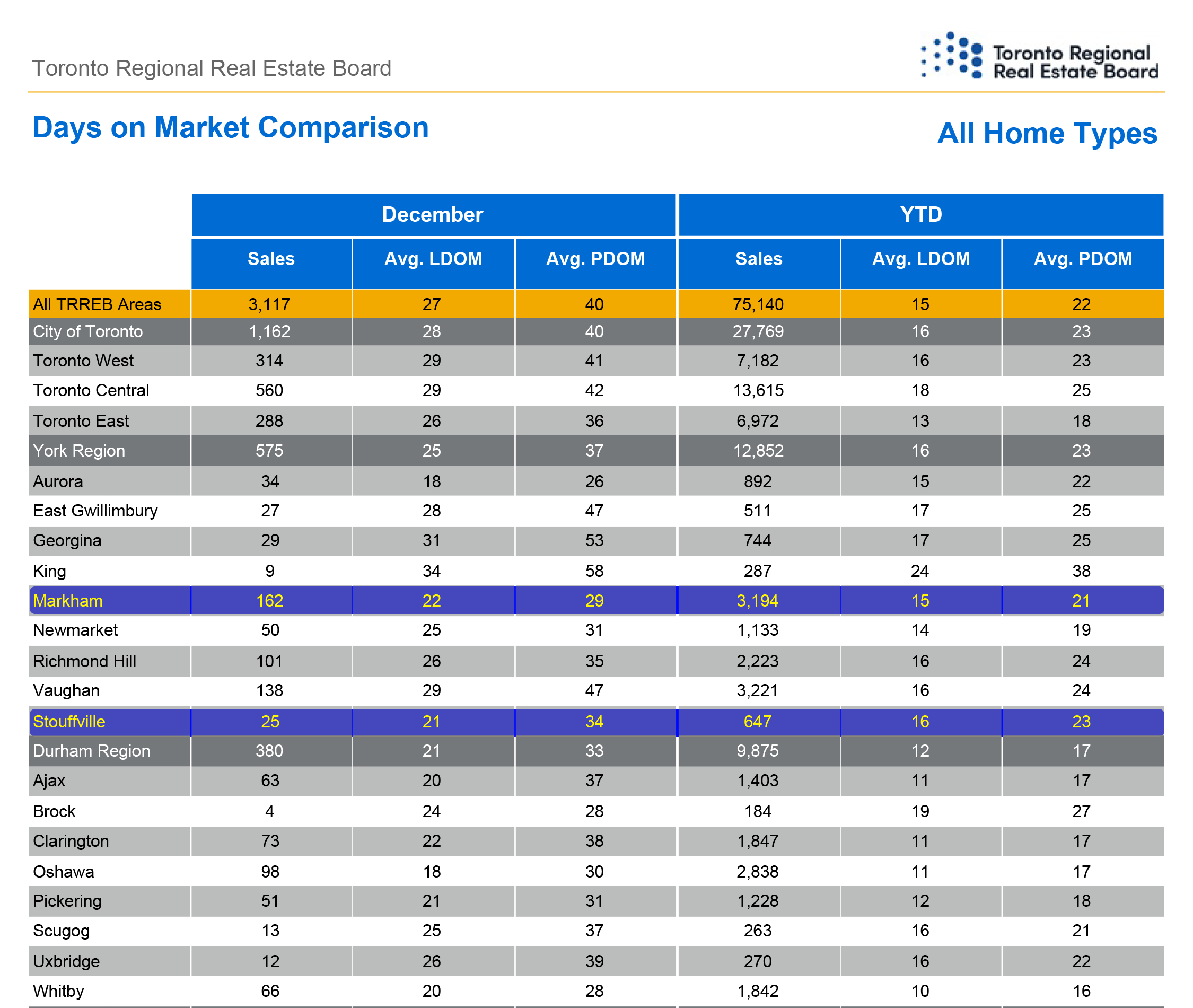
The Toronto Regional Real Estate Board has just released the latest PDOM data for December 2021. I’ve highlighted a couple of local areas of interest in the chart below.

Properties Days On Market - December 2021 TRREB

Markham and Stouffville both saw an expected increase in the total property-days-on-market for December, above the yearly average, with Markham’s increasing to 29, and Stouffville’s up to 34. This is a somewhat expected increase that we typically see in the slower-moving marketplace prior to the holiday season.

If you are interested in the full list for the TRREB market areas, click this link for the full PDF version.

👉🏻 Chat with us if you are curious to how this may affect your selling or buying strategy!

GTA REALTORS® Release October Stats

Despite the continued housing market transition to a higher borrowing cost environment, the average selling price in the Greater Toronto Area (GTA) found some support near $1.1 million since the late summer. GTA home sales continued to adjust to substantially higher interest rates in October 2022, both on an annual and monthly basis. However, new listings are also down year-over-year and month-over-month. The persistent lack of inventory helps explain why the downward trend in home prices experienced in the spring has flattened over the past three months.

GTA REALTORS® reported 4,961 sales through the Toronto Regional Real Estate Board’s (TRREB) MLS® System in October 2022 – a similar number to September 2022 but down by 49.1 per cent compared to October 2021. Yearover-year sales declines were similar across major market segments.

New listings were down by 11.6 per cent year-over-year and reached an October level not seen since 2010. New listings were down on an annual basis more so for mid-density and high-density home types, which helps to explain why prices have held up better in these categories compared to detached houses.

“With new listings at or near historic lows, a moderate uptick in demand from current levels would result in a noticeable tightening in the resale housing market in short order. Obviously, there is still a lot of short-term economic uncertainty. In the medium-to-long-term, however, the demand for housing will rebound. Public policy initiatives like the recently introduced provincial More Homes Built Faster Act and strong mayor provisions will help ensure we see more homes being built to affordably meet the needs of new households,” said TRREB President Kevin Crigger.

The MLS® Home Price Index (HPI) Composite Benchmark was down by 1.3 per cent year-over-year in October 2022. The average selling price for all home types combined, at $1,089,428, was down by 5.7 per cent compared to October 2021. The monthly trends for both the MLS® HPI Composite and the average selling price have flattened in recent months following steeper declines in the spring and early summer.

“Home prices in the GTA have found support in recent months because price declines in the spring and summer mitigated the impact of higher borrowing costs on average monthly mortgage payments. The Bank of Canada’s most recent messaging suggests that they are reaching the end of their tightening cycle. Bond yields dipped as a result, suggesting that fixed mortgage rates may trend lower moving forward, which would help affordability,” said TRREB Chief Market Analyst Jason Mercer.

NBA x REMAX

REMAX has just launched its new NBA marketing affiliation with the start of the 2022/23 basketball season.

YES IN YOUR HOUSE CONTEST

Official Real Estate Agents of the NBA

Enter today for your chance to WIN a customized, designer game night space in your house. YES, in your house.

https://www.remax.ca/yesinyourhouse

No Purchase Necessary. See site for official rules. CA residents, 21+, excl. QC. Ends November 21, 2022. Each office independently owned and operated.

Canadian Housing Market Outlook

RE/MAX Canada Network expects Canadian housing market prices to decrease 2.2 per cent this fall


Toronto, ON and Kelowna, BC, September 28, 2022 – RE/MAX brokers and agents are anticipating the national average residential sale price in the Canadian housing market to decline 2.2 per cent in the final months of the year (September-December), according to RE/MAX’s 2022 Fall Canadian Housing Market Outlook Report. This market moderation comes on the heels of rising interest rates, record-high inflation and broader global and economic uncertainties that have impacted consumer confidence and market activity. Bucking the downward trend, seven out of 30 Canadian housing markets analyzed are likely to experience modest price appreciation between 1.5 and seven per cent. Meanwhile, RE/MAX brokers and agents expect a decline in sales this fall, in 18 out of 30 markets surveyed.


Despite the fact that nearly half of Canadians are waiting to buy or sell a home, we’re confident that as economic conditions improve by mid-2023, activity will resume,” says Elton Ash, Executive Vice President, RE/MAX Canada. “Timing the market for short-term investment is extremely difficult and rarely successful. But as a long-term investment, the Canadian housing market continues to yield solid returns. If someone needs to buy or sell, regardless of those cyclical peaks and valleys, being informed and working with an experienced real estate professional can help consumers clarify some of those unknowns and make the best decision possible.”


Ontario

Much like other provinces across the country, Ontario has not been immune to the impacts of rising interest rates. Many markets including Oakville, Windsor, Barrie, Durham, Kingston and Kitchener-Waterloo, anticipate – and in some cases already experiencing – a reduction in the number of units sold over the coming months. Apart from Oakville and Muskoka, average residential sale prices in Ontario are likely to remain steady or decrease between two to 10 per cent in the fall months.

Similar to Western Canada, the luxury market has remained resilient and in-demand among buyers in Oakville, despite rising interest rates and a looming recession – a contributing factor to the modest two-per-cent average residential sale price increase expected in Oakville this fall. Muskoka continues to attract homebuyers to the area, while simultaneously, many sellers are eager to sell before year-end. Given a steady stream of demand, Muskoka is expected to experience a modest five-per-cent increase in average residential sale price this fall. In Peterborough, interest rate hikes and the subsequent effects on the stress test have eroded affordability in the area, which is the main factor contributing to the seven-per-cent decrease in average residential sale price expected in the coming months. The return of conditional offers has been a prevalent trend across the province, including in Kingston, Kitchener-Waterloo, Muskoka and Peterborough. Echoing many regions across Canada, Durham, London, Sudbury, Ottawa, the Lakelands and the Greater Toronto housing market are expected to regain balance in 2023, albeit with low inventory continuing to place upward pressure on prices. As one of the more affordable markets in Ontario, Thunder Bay is unlikely to experience any significant fluctuations in average residential sale prices this fall.