!-- Google Site Verification -->

Markham Endorses Private Plumbing Protection Program

To further protect properties from basement flooding, Markham City Council has endorsed the Private Plumbing Protection Rebate Program. The program offers financial support for property owners who are making certain improvements on their private plumbing system.

Three private plumbing protection measures can be implemented to help protect your property.

Severe rain events can overwhelm the City’s wastewater and storm water sewer systems, especially in older neighbourhoods where the systems weren’t designed and constructed up to today’s standards. Markham has invested millions of dollars to improve City sewer systems. To further protect properties from basement flooding, City Council has endorsed the Private Plumbing Protection Rebate Program. The program offers financial support for property owners who are making certain improvements on their private plumbing system.

Three private plumbing protection measures can be implemented to help protect your property.

1. Backwater Valve Installation. A backwater valve is a device that acts as a ‘check valve’ that allows sewage or stormwater to flow out of the home’s plumbing system during normal conditions, and prevents back flow of sewage or stormwater into your home during storms.

Backwater / Backflow Prevention Valve

Backwater / Backflow Prevention Valve


2. Weeping Tile Disconnection and Sump Pump Installation. Weeping tiles (also called foundation drains) collect groundwater or infiltrated rainwater from around the outside of homes and may directly connect to municipal sewer systems. Disconnecting weeping tiles from municipal sewers and installing a sump pump can help prevent infiltration flooding through foundation walls or the floor when municipal sewers surcharge during large storm events.

3. Sanitary and Storm Lateral Relining and Repair. Sanitary and storm laterals are underground pipes that carry wastewater or drainage away from your property to the City sewer systems. Blocked or collapsed laterals can cause a sewer backup in your basement.

Who will receive a rebate?

Property owners who install protection measures are eligible to receive City rebates subject to certain conditions and submission of a rebate application form.

Retroactive Rebate– Property owners who completed installations between May 1, 2017 and May 1, 2018 are eligible for a retroactive rebate subject to City inspections. 

New Installation Rebate – Property owners who complete work after May 1, 2018 are eligible for a new installation rebate subject to obtaining necessary building permits and City inspections. This pilot program will run for the next two years.

Property owners are eligible for rebates subject to the following:

  • Your home is connected to the City’s sewer system

  • Your property is not subject to any contraventions, work orders or outstanding municipal requirements

  • No outstanding municipal fines, tax payments, or fees

  • Downspouts have been disconnected from the City sewer system

  • As the Property Owner, provide the necessary documentation required in the application forms, and comply with program requirements

  • You have obtained any necessary permits for the New Installation

  • As the Property Owner, ensure the new installation adheres to the Building Code Act

  • You agree to sign a release form in favour of the City

More details provided in the City By-law 2018-20 [PDF].

What Rebates Are Available?

Private Plumbing Protection MeasureMaximum RebateBackwater Valve (Indoor) – Installed on Sanitary Lateral$1,750Backwater Valve (Indoor) – Installed on Storm Lateral$1,750Backwater Valve (Outdoor) – Installed on Storm Lateral$2,000Weeping Tile Disconnection and Redirect to Storm Lateral$3,000Weeping Tile Disconnection and Sump Pump Installation$5,000Storm Lateral – Reline & Repair$2,500Sanitary Lateral – Reline & Repair$2,500

How to Apply?

Application process:

New Installation (measures implemented after May 1, 2018)

  • Step 1: Property owner(s) need to consult with a licensed plumber to determine which measures may provide basement flood protection and to confirm eligible rebate(s) amount.

  • Step 2: Property owner(s) submit a building permit application to the City and Building Department issues the permit.

  • Step 3: Property owner(s) hire licensed plumber to complete the installation.

  • Step 4: Building Department inspects completed installations.

  • Step 5: Property owners submit rebate application form including invoices to Environmental Services.

  • Step 6: City issues rebate cheque to Property owner(s).

Download New Installation Application Package [PDF].

Retroactive Installation (measures implemented between May 1, 2017 and May 1, 2018)

  • Step 1: Property owners confirm eligible rebate amount for completed work

  • Step 2: Property owners submit rebate application

  • Step 3: City’s consultant inspects completed works and recommends any additional measures

  • Step 4: City issues rebate to Property owners

  • Step 5: Property owners follow process for new installation for additional measures

Download Retroactive Installation Application Package [PDF].

Additional Resources

Selecting a Contractor 

The City of Markham is not affiliated with any contractors engaged in completing plumbing protection works under the rebate program.  Property owners are encouraged to learn the steps in hiring a contractor and to ask questions to find the best candidate for any home or property project.  Tips can be found from the Canada Mortgage and Housing Corporation.

For more information, please contact the City of Markham at 905.477.5530

New 2020 Tax Changes - Purchasing Homes

Some major tax changes took effect as of January 1st - Now allowing those dissolving their marriage or common-law partnership to qualify to withdraw money from their RRSP, without incurring a tax penalty, to purchase a home.

Read More on Global News: https://globalnews.ca/news/6352374/rrsp-tax-changes-2020/…

What's driving Toronto's Housing Prices

RE/MAX Canada posted a great take on the drivers behind Toronto’s market recovery and housing prices. From RE/MAX.ca:

The real estate sector can be a real mystery. Prices drive ever higher, drop, and then get back to soaring again with no apparent reason. Or is there a reason? There’s always something responsible for driving up housing prices. For Toronto, the spotlight has returned to detached housing, which has pulled up the average price for the first half of 2019.

Upward Momentum

“With recovery well underway in the detached housing segment, the residential real estate market is starting to fire on all cylinders,” says Christopher Alexander, Executive Vice President and Regional Director RE/MAX of Ontario-Atlantic Canada. “The possibility of more relaxed mortgage rules down the road – in conjunction with today’s low interest rate environment – may serve to spark up the GTA housing market yet again.”

According to the Toronto Real Estate Board (TREB), over half of their districts report upward momentum in average price thanks to single-detached home sales. This is a major contributor to the uptick in average price, in over 50% of the GTA’s neighbourhoods, according to a RE/MAX of Ontario-Atlantic Canada report.

The report looked at trends and developments in 65 TREB districts. They discovered detached home sales were up in close to 88% of the markets. Between January and June 2019, 51% of markets saw increases compared to last year.

Good Old 905

The greatest increases were seen in the 905 area. The report indicates all 30 905 neighbourhoods saw an increase in both home-buying activity and rising sales of detached homes. Of those communities, 43% experienced price appreciation. Meanwhile, in the once-dominant 416 area, 20 of the 35 districts experienced an increase in sales. Detached prices in these areas increased by 57% of the 416 neighbourhoods.

Back on Track

Torontonian detached homeowners can let out a sigh of relief as detached housing has found its way back on track. Year-to-date increases in sales are almost 17% ahead of last year. That is good news, and it indicates a return to more normal levels of home-buying activity.

 “Market share is also climbing, with detached homes now representing 45.7 per cent of all home sales in the Greater Toronto Area, up from 43.1 per cent one year ago,” says Alexander.

Greater Affordability

So, it’s back to wondering why detached home sales are seeing an uptick. In this case, it’s all about greater affordability. However, RE/MAX also found the tried-and-true mantra “location, location, location” to be a factor as well.

First-time and trade-up buyers are choosing to secure prime Toronto real estate before values are on the move again, especially in light of the stress test. The leader, when looking at the percentage increase in average detached home price, is the city’s east end, which includes North Riverdale, South Riverdale, Blake-Jones, and Greenwood-Coxwell (EO1). Here, the average price rose 15.2% to $1,378,987.

Not too far behind is the always-popular Trinity-Bellwoods, Palmerston-Little Italy, Niagara, Little Portugal, Kensington-Chinatown, and Dufferin Grove (CO1). These popular neighbourhoods saw a 12.8% increase in average price, reaching $1,953,511.

Rounding out the top five are:

Third place: Leaside and Thorncliffe Park (C11) held a respectable third place with an 11.2% increase in detached housing values to $2,193,747.

Fourth place: Scarborough’s Dorset Park, Wexford-Maryvale, Clairlea-Birchmount, Longview, and Kennedy Park (E04) with a 7.8% increase to $836,585.

 Fifth place: Toronto’s Junction, High Park North, Runnymede-Bloor West Village, Lambton-Baby Point, and Dovercourt-Wallace Emerson-Junction (W02) with a 7.1% increase to $1,410,057.

Prices in all but the one area in Scarborough still sit well above the $1-million mark.

Top Five: Seller’s Markets

TREB Market Watch reports the top five neighbourhoods as seller’s markets in June. A classic seller’s market is characterized by low inventory levels, which in some cases, can lead to bidding wars. In other words, a seller’s dream.

As well, TREB reported the sales-to-active listings ratio ranged between 62.5% in C01 to a high of 88.8% in E01.

Buyer’s Markets

In about 45% of GTA districts within the 416 area, good inventory means it’s a buyer’s market. RE/MAX noted areas north of Bloor had attracted opportunities for negotiation, particularly for homes that are topping $2 million. Going further south, the market conditions get tighter.

“Heated demand clearly exists for single-detached housing south of Bloor Street, but there are pockets throughout the 416 that are scorching hot,” explains Alexander. “The Oakwood-Vaughan area in C03, where homes can still be had for just over the $1 million price point, is one of those neighbourhoods, while C10, comprised of Sherwood Park, Mount Pleasant West, Mount Pleasant East, is another. The Junction Area, High Park North, and Runnymede-Bloor West Village (W02) in the west end and Leslieville (E01) and the Beach (E02) in the east are also highly sought-after, with close proximity to transportation and vibrant shopping avenues the common denominators drawing younger buyers.”

First-time buyers can look for cracks that can be exploited in York Region to get the best value if they want to get in on the market.

Scarborough Rules Unit Sales

If you want to talk unit sales, the top performers were markets offering single-detached homes under the $1-million price point, with Scarborough’s L’Amoreaux, Tam O’Shanter-Sullivan, Steeles neighbourhood (E05) at the top. This area experienced the most notable upswing when considering the percentage increase in sales. This little pocket saw a 76.2% increase to 148 units sold.

The other areas seeing unit sales increases include:

Milliken, Agincourt North, Agincourt South, and Malvern West (E07) ranked second, with a 57.1% increase and 132 sales.

 Yorkdale-Glen Park, Briar Hill-Belgravia, Brookhaven-Amesbury, Weston, Maple Leaf, Rustic, Beechborough-Greenbrook, Mount Dennis, Humberlea, and Pelmo Park (W04) in the west end reported a 50% gain to 204 units sold.

 Simcoe County’s Essa reported a 43.6% increase in sales of 168 units.

 Downsview-Roding-CFB, Glenfield-Jane Heights, Black Creek, Humbermede, York University Heights, and Humberlea-Pelmo Park (W05) in the west end rounded out the top five with a 37.1% increase in sales to 144 units.

Recovery to the North

There are signs of recovery to the north, with York Region’s Richmond Hill ranking sixth for detached home sales at an average price of $1,380,253. This reflects a 36.1% increase to 615 sales. In general, the northern GTA, an area that was hit hard during the correction, appears to be experiencing recovery.

So, it’s hats off to the detached housing segment as the key factor for what is driving Toronto real estate prices!

Summer winds down, and the market warms up!

September Sales

With the back-to-school season behind us now, many families turn their focus back into the real estate market, and we see our noteworthy ‘second bump’ of the year.  September has typically been a busy month, since sales during the month usually end up with a closing date in advance of the Christmas holiday season, which many find desirable.  We’ve already seen a marked increase in activity through York Region - notably in the Eastern portion of Markham.

38SirKay-Sold

Congratulations to our wonderful Clients on the recent sale of their family home!  38 Sir Kay was a fantastic property, and a pleasure to show and bring to the market.

HST Rebate on Income Property Purchases

When purchasing a newly-built property with the intention of utilizing it as a rental property, GST/HST is paid as part of the transaction, however you may be eligible for a GST/HST rebate.

The new residential rental property rebate (NRRP) is applicable provided you have a Tenant who has signed a lease for at least one year duration (month-to-month leases are not applicable). When you purchase a new residential property to for income-generating purposes, the builder or developer is not permitted to apply for the new home HST rebate on your behalf - unlike like they would if the property was going to be your primary residence.

Consequently, the Buyer will be required to pay the HST for the property up-front, and then will have to apply to receive a refund from the Canada Revenue Agency. Be prepared - as this can put a temporary financial strain on Buyers that may not have budgeted for the additional cash-flow and interest expense.

We highly recommend engaging a financial planning professional to maximize your rebates, and ensuring you apply for your full HST rebate as quickly as possible upon closing of your property. One of the key criteria is ensuring you have a fully-accepted ‘agreement to lease’ prior to the closing date of your investment!

Have questions about buying your first income property? We are here to help! Contact The MAC Team any time for advice and guidance.

Make sure you have the right advice and guidance when making your Investment property choices.

Make sure you have the right advice and guidance when making your Investment property choices.

Congrats on an exciting sale!

We’re thrilled for our Sellers of their lovely home at 3 Wismer Place in Markham! Sold in just a week, it’s nice to see the market activity heating up for well appointed homes like this one. Originally built in 1850, and situated in what is now known as “Angus Glen”, this home was relocated into the Markham Heritage Estates in 2000, and fully rebuilt to todays modern standards. Truly a unique gem in today’s marketplace!

RRSP Home Buyer's Plan Information

This can be a great way to extend your funds available for a home purchase, utilizing income you already have.


The Home Buyers’ Plan (HBP) is a program under which you can, generally, with- draw up to $25,000 from your registered retirement savings plan (RRSPs) to buy or build a qualifying home. Withdrawals that meet all applicable HBP conditions do not have to be included in your income, and your RRSP issuer will not withhold tax on these amounts. However, before you can withdraw funds you must have entered into a written agreement to buy or build a qualifying home which you must occupy no later than one year after buying or building the home. If you buy the qualifying home together with your spouse or other individuals, each of you can withdraw up to $25,000. You cannot with- draw an amount from your RRSP under the HBP if you or your spouse owned the home more than 30 days before the date of your withdrawal.

For more info, download this informational PDF here.

Revisiting the "Mortgage Stress Test"

The Toronto Star has a great article today suggesting that it may be time for Ottawa to revisit the year-old Mortgage Stress Test. The Mortgage Professionals of Canada group released their own report, indicating how the current structure of the stress-test does not accurately reflect Canadians buying-power, nor does it take into account the decreasing primary mortgage amount, as payments occur over the life of the mortgage.

We have all seen the tremendous impact these rules have had - not only on first-time Buyers, but on many current homeowners looking for end of term renewals.

Read the full article here: Revisiting Mortgage Stress Test rules.

TREB December and 2018 Annual Statistics Released

Always good to keep your eye on the Market Trends around the GTA. The Toronto Real Estate Board recently released their 2018 Annual Statistics, which show a general slowing of the Market as compared to 2017, as we all expected.

January 4, 2019 -- Toronto Real Estate Board President Garry Bhaura announced that Greater Toronto Area REALTORS® reported a total of 77,426 residential transactions through TREB's MLS® System in 2018. This result represented a 16.1 per cent decline compared to 92,263 sales reported in 2017. Total new listings entered into TREB's MLS® System were down by 12.7 per cent over the same period to 155,823.

The overall average selling price for 2018 transactions, at $787,300, was down by 4.3 per cent year-over-year for all home types combined across the TREB market area. 

Home prices were up very slightly in the City of Toronto and down in the surrounding GTA regions. This dichotomy reflects the fact that the condominium apartment segment, which accounted for a large proportion of sales in the City of Toronto, performed better from a pricing perspective than the detached market segment. The average price for condominium apartment sales across the TREB market area was up by 7.8 per cent year-over-year. 

"Higher borrowing costs coupled with the new mortgage stress test certainly prompted some households to temporarily move to the sidelines to reassess their housing options. With this said, it is important to note that market conditions were improved in the second
half of the year, both from a sales and pricing standpoint," said Garry Bhaura. 

"After spiking in 2017, new listings receded markedly in 2018. In many neighbourhoods, despite fewer sales from a historic perspective, some buyers still struggled to find a home meeting their needs. The result was a resumption of a moderate year-over-year pace of home price growth in the second half of the year. Price growth was strongest for lessexpensive home types, as many home buyers sought more affordable home ownership options," said Jason Mercer, TREB's Director of Market Analysis and Service Channels.

You can download a PDF of the complete 2018 Real Estate Market Statistics report here.

Residential Transaction Volume Up

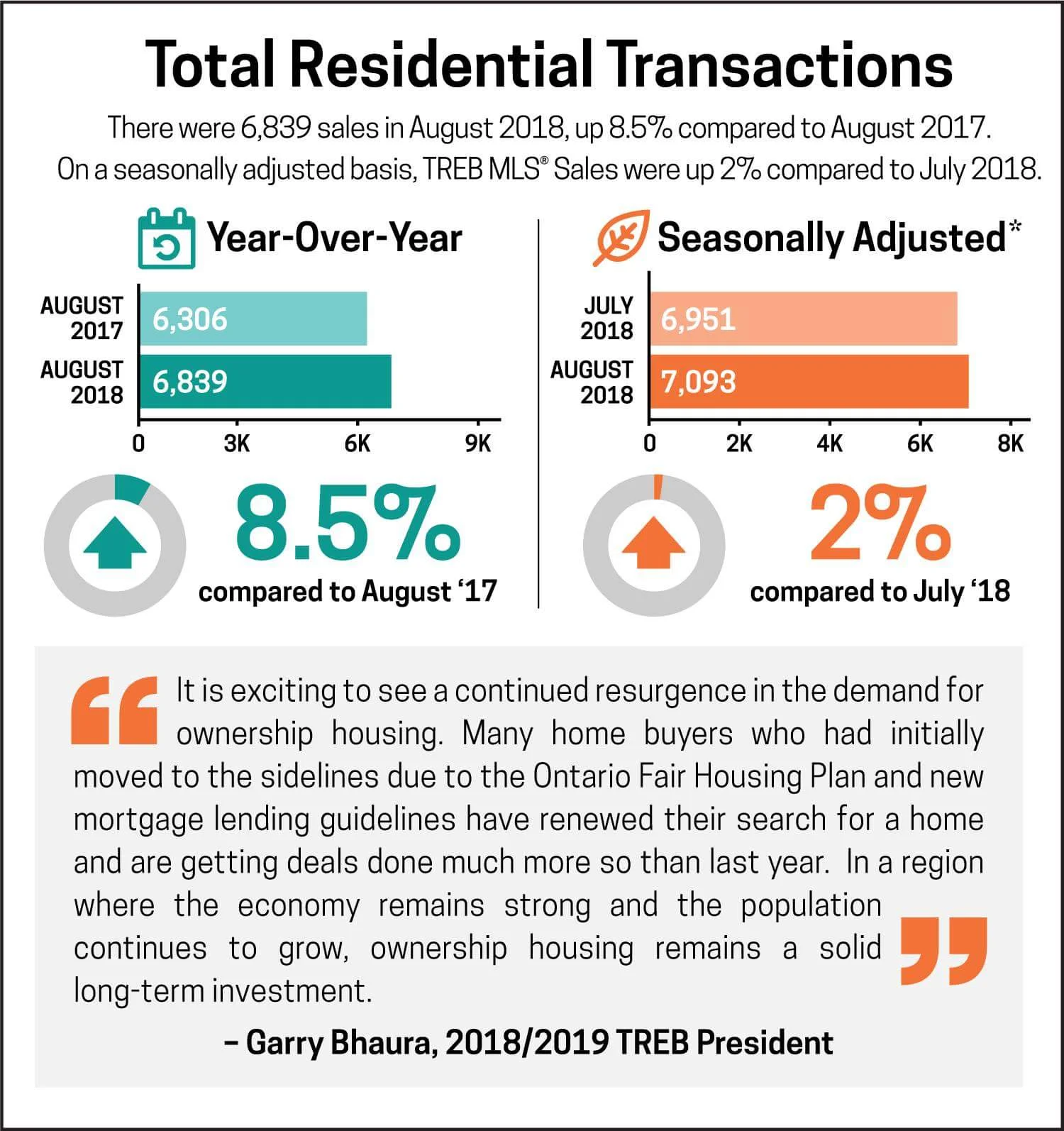
While heavily weighted by the core of Toronto, the Toronto Real Estate Board reported this week that August transactions were up year-over-year.

There were 6,839 sales in August 2018 - up 8.5% versus 2017. Seasonally-adjusted volume puts sales up 2% versus July 2018.

TREB Statistics - August 2018 Sales Volume

TREB Statistics - August 2018 Sales Volume

With increased stability around the GTA, we expect to see volume increasing in the ‘905’ areas, including the core Unionville, Markham and Richmond Hill areas. September is looking to be a solid month for new listings, and overall sales activity.


Positive News on Home Prices: CMHC expecting prices to rise

Global News reports today:

Home Prices in Ontario expected to increase moderately: CMHC

OTTAWA — A report by Canada Mortgage and Housing Corp. says a recent drop in Ontario home prices isn’t expected to persist.

It says moderate economic growth in the Greater Toronto Area and Ontario generally will provide support for provincial real estate prices in 2018 and 2019.

CMHC expects inflation-adjusted home prices in the province will remain relatively stable and close to the levels of last year’s fourth quarter.

It anticipates prospective buyers will face fewer bidding wars and feel less urgency to act, allowing them time for more informed decision making.

On the flip side, CMHC says home owners may see their properties on the market longer than usual.

Global News Article Link

From Canada Mortgage and Housing Corporation:

“The current Ontario price correction fails to fully resemble historical price bust periods. Home prices are plateauing and are expected to grow along a more sustainable linear path supported by continued economic growth, moderate increases in interest rates and only modest increases in new housing supply.” - Ted Tsiakopoulos, Ontario Regional Economist

Download CMHC Housing Market Insight for June 2018 (PDF)